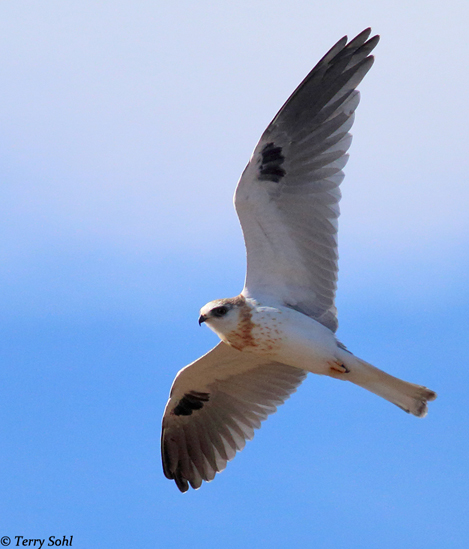
Once considered endangered in North America, the White-tailed Kite has greatly expanded in numbers and range since the 1930s. They are heavily dependent upon large populations of small rodents such as mice and voles, and probably have benefited greatly from the introduction of the House Mouse to North America. Previously known as the Black-shouldered Kite.
Habitat
Prefers open habitats with perches for hunting, and with suitable nesting sites. This includes marshes and wetlands, farmland, grassland, and prairie.Diet
Primarily feeds on small rodents, especially mice and voles. Will also eat other small mammals, birds, and occasionally snakes, lizards, frogs, and large insects.Behavior
The White-tailed Kite is a graceful, buoyant hunter often seen hovering in place with wings raised in a shallow V before dropping suddenly onto prey in grasslands or marsh edges. It spends much of its time gliding low over open country or perched conspicuously on fenceposts and isolated trees scanning for rodents. Compared with many hawks, its flight appears light, tern-like, and almost effortless.Breeding
Non-breeder in South Dakota. In their breeding range, the White-tailed Kite builds a small but sturdy stick nest high in a tree or large shrub, usually near open hunting habitat such as pasture, marsh, or agricultural land. The female typically lays 3 to 5 eggs, while the male supplies much of the food during incubation and early nestling stages. Both parents aggressively defend the nest area and continue feeding the young for some time after they leave the nest.Song
The White-tailed Kite gives thin, high, squealing whistles and sharp repeated klee-klee-klee calls, especially near the nest or when alarmed. Although often silent while hunting, it becomes quite vocal during courtship and territorial disputes.White-tailed Kite (pair of breeding adults)
White-tailed Kite "Whistle-croak" call
