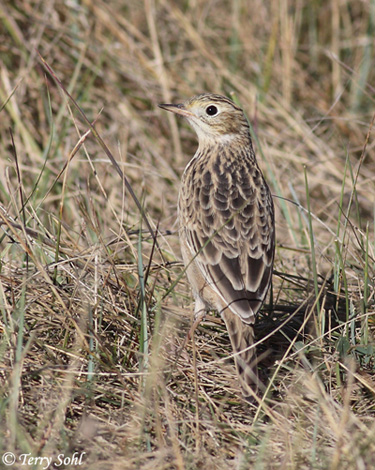
Sprague's Pipits can be difficult to observe, given their tendency to freeze or run when approach rather than fly. They also tend to be found singly or in pairs, not in flocks like the American Pipit. They are true birds of the shortgrass prairie, and have declined as this native habitat has been converted to agricultural land. While normally found on the ground, they perform one of the longest flight displays of any bird.
Habitat
The Sprague's Pipit is a bird of wide, open native prairies, favoring lightly to moderately grazed mixed-grass and shortgrass plains with little shrub cover. During migration and winter it also uses hayfields, stubble, and expansive grasslands, but it remains strongly tied to treeless open country.Diet
Summer diet in South Dakota is primarily insects, but they will also feed on the seeds of grasses and weeds. The winter diet includes a greater proportion of seeds.Behavior
The Sprague's Pipit is a secretive ground-dweller that usually walks or runs through grass rather than flushing until closely approached, often disappearing into cover. In the breeding season the male becomes much more conspicuous, rising high into the sky on fluttering wings to deliver long, cascading songs before parachuting back down to the prairie.Nesting
June and July in South Dakota. The Sprague's Pipit nests on the ground in open prairie, placing its well-hidden cup in a shallow depression tucked beneath a clump of grass. The female lines the nest with fine grasses and plant fibers, lays 3 to 6 eggs, and relies heavily on camouflage and stillness to avoid detection. Both parents feed the young insects after hatching during the short northern grassland summer.Song
The Sprague's Pipit gives thin, high-pitched tsip contact calls that are easily missed over windy prairie. Its most distinctive vocalization is the male’s long, delicate, cascading song, delivered almost continuously during an elevated fluttering display flight high above the grasslands.Migration
Summers in the northern Great Plains and southern Canada. Winters in Texas and Mexico.Interactive eBird map
Click to access an interactive eBird map of Sprague's Pipit sightings
Similar Species
American Pipit, Vesper Sparrow. The Sprague's Pipit is a pale, finely streaked prairie bird with a slim bill, buffy face, and relatively plain outer tail, usually preferring drier native grasslands. American Pipit is grayer, more sharply streaked on the breast, often shows stronger white in the outer tail during flight, and is commonly found in wetter flats, shorelines, or plowed fields during migration. Vesper Sparrow is chunkier with a thicker sparrow bill, bolder white outer tail feathers, chestnut shoulder tones, and a clearer white eye-ring, lacking the slim pipit shape and upright stance.Conservation Status
Has declined throughout much of its historic range due to habitat loss as agricultural lands replace native prairie. Grazing activity and other land management activities on remaining grasslands also threaten the species. The species has recently been declining at a rate of over 20% per decade, and as a result, the IUCN currently classifies Sprague's Pipit as a "vulnerable" species.
Photo Information
September 25th, 2011 -- Fort Pierre National Grasslands, Richland Wildlife Area -- Terry Sohl
