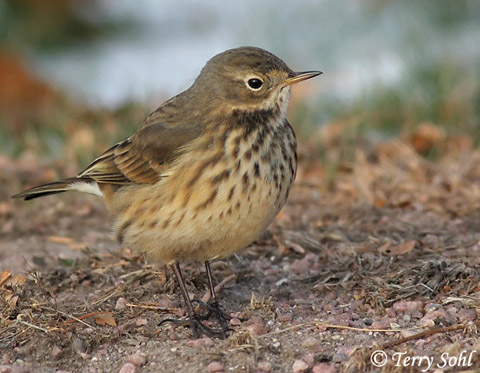
Related to a group called the "wagtails", American Pipits share their habit of wagging their tails when walking over open territory. They can be found throughout North America at some point during the year, nesting in the far north and high elevations in the west in summer, migrating throughout much of the continent in spring and fall, and wintering in in the southern U.S. and near the coasts.
American Pipits are formerly known as the "Water Pipit", and they are often found near water sources. In migration in South Dakota, beaches, gravel roads cutting through wetlands and lakes, and rocky rip-rap along lake shorelines are some of the best locations to find them. The species is also found in the eastern Hemisphere, where they are known as the "Buff-bellied Pipit".
Habitat
Prefers open terrain during migration through the state, including mudflats, beaches, sandbars, and barren fields. I've also often found them on rocky rip-rap around lakes and reservoirs in South Dakota. American Pipits are unique in that they have two very different areas they breed during the summer months, with the one common feature for both is colder temperatures. Throughout western North America, they breed in scattered locations in and around barren areas in high-elevation alpine habitat.
They also can be found as a breeding bird in far northern North America in tundra habitats.
Diet
Mostly insects. Will also eat seeds, especially those wintering inland.
Behavior
Feeds by walking along the ground, looking for insects. They are normally found in flocks, except during the breeding season.
Breeding
Non-breeder in South Dakota, with their breeding grounds at higher elevation in scattered locations throughout western North America, and in northern Canada and Alaska. The nest of an American Pipit is a small cup of grasses, lined with finer grasses and hair, placed in an open location, but with the nest site placed next to a rock or clump of vegetation to partially protect it. The female lays between 3 and 6 eggs, and she alone incubates them.
Incubation lasts about 12-14 days, with the young fledging from the nest after another 12-14 days.
Interactive eBird Map
Click to access an interactive eBird map of American Pipit sightings.
Song
Rapid series in flight of chweee-chweee-chweee. They also have a call that sounds, surprisingly like "pi-pit", with the second part higher in pitch.
- Click here to hear alarm and other calls of an American Pipit
- Click here to hear a call an American Pipit
- Click here to hear a display flight of an American Pipit
Migration
Summers in Northern Canada, British Columbia, Alaska, and high elevations in the Rocky Mountains. Winters in the southern U.S., along the coasts, and points south.
Similar Species
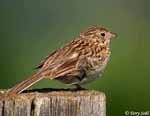
American Pipits are rather unique in plumage and structure, a "robin" or thrush-type structure and size, but with a unique plumage and only one other close relative in South Dakota. Here are the species most likely to be confused with an American Pipit:
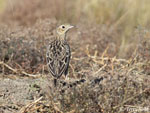
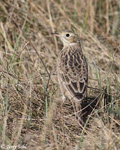
- Sprague's Pipit - The other pipit species that could possibly be seen in South Dakota, Sprague's Pipit breed in the northcentral and northwestern part of the state, but typically are rather difficult to find. They're similar in size and structure, but plumage differences are obvious if seen well. Sprague's Pipits have very "scaly" backs, while the backs of American Pipits are much more uniform in color. Sprague's Pipits lack the eye ring of an American Pipit, have pale legs instead of dark legs, and lack the yellowish to orangish tones often found on the underside of a breeding plumaged American Pipit.
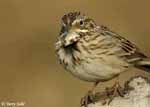
- Vesper Sparrow - On the list because of two features that could cause confusion from a distance. Both species have an eye-ring and streaking on their underparts. However, the bills are dramatically different, with a very thin bill on an American Pipit, and a stout bill on a Vesper Sparrow. Vesper Sparrows also have substantial streaking on their back compared to the cleaner, uniformly colored back of an American Pipit.
Conservation Status
Systematic surveys in recent decades have shown small declines in overall populations of American Pipit. However, they are still found across a very broad geographic area, and are common in parts of their range. The IUCN considers the American Pipit to be a species of "Least Concern".
Further Information
- eBird - American Pipit
- Audubon Field Guide - American Pipit
- Cornell All About Birds - American Pipit
Photo Information
November 10th, 2008 - Wall Lake in Minnehaha County, South Dakota - Terry Sohl
Audio File Credits
- Paul Marvin. Recorded in Imperial Beach, California on December 7th, 2020. Original recording and information available from xeno-canto.
- Logan McLeod. Recorded in the Yukon Territory of Alaska on June 4th, 2018. Original recording and information available from xeno-canto.
- Paul Marvin. Recorded in Carbon County, Montana on May 31st, 2015. Original recording and information available from xeno-canto.
