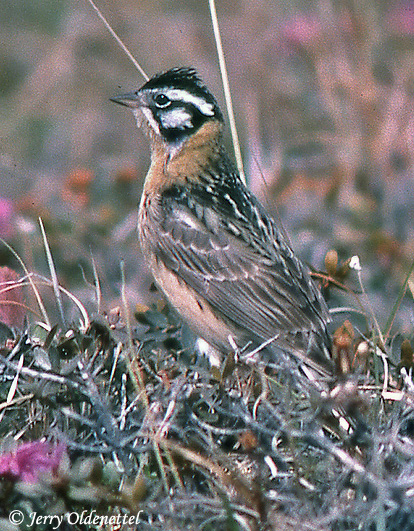
ID Keys: Winter birds have buffy underparts and nape, with a strong facial
pattern on the male. White outer feathers bordering a black tail
are prominent in flight.
The Smith's Longspur is
usually a rare migrant through the state as they move between their Arctic
summering grounds and their wintering grounds on the southern Great
Plains. They generally don't mingle with other longspurs or Horned
Larks. They are known for their odd breeding behavior, in which males
vigorously sing to attract females, but don't defend territories, are highly
promiscuous, and often have nests of mixed parentage.
Habitat
Found near the treeline in the Arctic in the
summer, primarily in grassy areas with scattered shrubs or stunted trees.
In winter, they are primarily found on heavily grazed fields, shortgrass
prairie, and large "urban" grass expanses, such as around airports.
Diet
Primarily seeds, with
seeds making up a large portion of the diet in all seasons. Also will feed
heavily on insects and spiders in the summer.
Behavior
Gregarious outside of the nesting
season, foraging in flocks. Does nearly all its foraging by walking
and running about on the ground.
Breeding Map
Non-breeder in South Dakota.
Song
Thin sweet warbling.
Migration
Summers in the Arctic. Winters in
the southern Great Plains and southern Mississippi river area.