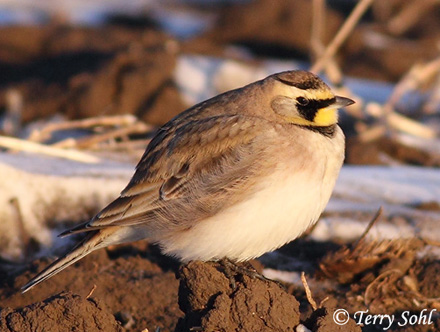
A hardy, all-season bird of open areas. Horned Larks are pretty common most of the year in much of South Dakota, but they're often quite hard to observe closely. Most of the year, they often go unnoticed. However, they're much more observable with a fresh snow on the ground, as they often congregate in numbers along gravel roadsides, along with Lapland Longspurs and Snow Buntings. The "horns" of the Horned Lark are in fact quite small, black tufts of feathers that can only be seen at very close range.
Habitat
Found in a wide variety of settings. Prefers open ground with little or no tall vegetation, such as barren or plowed fields, large grass lawns, and beaches.
Diet
Mostly seeds and waste grain in the winter. Insects are also eaten in great quantity during the summer.
Behavior
Gregarious, usually found in flocks except during the nesting season. Forages by walking or running on the ground in search of insects and seeds.
Nesting
April through June. The Horned Lark nests on the ground in open barren country, placing its shallow cup in a small depression often tucked beside a clod, tuft of grass, or stone for shelter. The female lines the nest with fine grasses, rootlets, hair, or feathers and lays 2 to 5 eggs, while both parents feed the young insects after hatching. Ground coloration and surrounding pebbles help conceal both nest and incubating bird remarkably well.
Song
The Horned Lark gives thin, tinkling contact notes and soft, high tsee calls that are sometimes difficult to hear in its normal windy open country habitats. Its song is a delicate, sweet series of jingling notes often delivered during a hovering or fluttering song flight high above the ground.
Migration
Found throughout much of North America, most U.S. populations are permanent residents. Those in the northern part of Canada do move southward for the winter.
Interactive eBird Map
Click here to access an interactive eBird map of Horned Lark sightings
Similar Species
Generally distinctive if seen well
Conservation Status
Widespread and common. Horned Larks have adapted well to a human presence, and will utilize farmland or other heavily disturbed lands. Their overall numbers appear to be declining, but overall the IUCN considers the Horned Lark to be a species of "least concern".
Further Information
- eBird - Horned Lark
- Audubon Field Guide - Horned Lark
- Cornell Lab of Ornithology - All About Birds: Horned Lark
Photo Information
January 21st, 2009 - Minnehaha County, South Dakota - Terry Sohl
