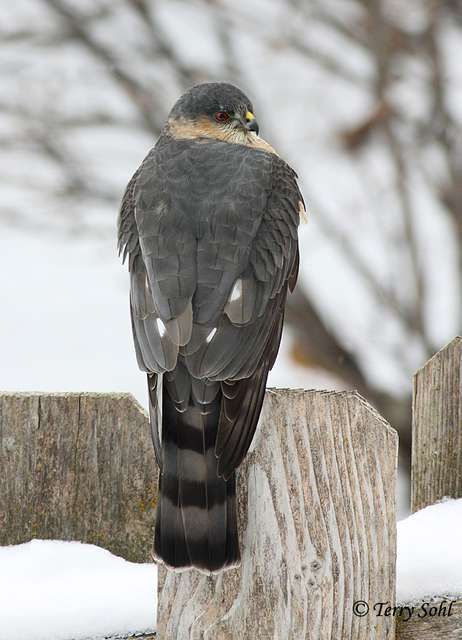
Named after the flattened thin leg shanks, the Sharp-shinned Hawk usually is found in dense woods when on its summer breeding grounds. However, in migration an in winter, they can be found in a wide variety of habitats. They've adapted well to a human presence and can often be found near bird feeders, where they are absolutely deadly hunters. Showing strong migratory behavior, large numbers can sometimes be seen along coastlines and ridgelines as they move south in the fall.
The Sharp-shinned is the smallest of the "Accipiter" hawks. Overall appearance and plumage is extremely similar to the larger Cooper's Hawk, and differentiating between the two species can be difficult. See Identification below for key characteristics for identifying a Sharp-shinned Hawk.
Habitat
Generally avoids open country, preferring forest land ranging from dense to semi-open. Usually nests in conifer stands found in mixed forests. Can sometimes be found in urban areas in winter as it feeds on birds attracted to feeders.
Diet
Primarily feeds on small birds. Will also feed on small mammals, snakes, lizards, frogs, and insects.
Behavior
Sharp-shinned Hawks often hunt by observing from a partially obscured perch, waiting for prey to appear, or by taking prey by surprise as it flies through cover. They are incredibly swift and acrobatic in pursuing and catching prey in flight. Increasingly, Sharp-shinned Hawks have learned to hunt around feeders, especially in winter, taking advantage of the sometimes unnatural concentration of small prey species.
Nesting
May through July. The nest of a Sharp-shinned Hawk is a platform of sticks, lined with bits of grass, smaller twigs, and bark. The female usually lays 4 or 5 eggs, and she alone incubates them, with the male bringing her food during the incubation period. When the eggs hatch, the male initially brings food to the young while the female stays with the young. After about 2 weeks, both parents help to feed the young. The young fledge after about 6 weeks.
Song
Migration
Most are migratory, except for some permanent residents throughout parts of the west and in the Appalachians. Summers in Canada, the northern U.S., and higher elevations of the West and in the Appalachians. Winters throughout much of the southern 2/3rds of the U.S. and south through Mexico and Central America.
Interactive eBird map
<a href="https
//ebird.org/map/shshaw?neg=true&env.minX=&env.minY=&env.maxX=&env.maxY=&zh=false&gp=false&ev=Z&mr=1-12&bmo=1&emo=12&yr=all&byr=1900&eyr=2021" rel="noopener noreferrer" target="_blank">Click here to access an interactive eBird map of Sharp-shinned Hawk sightingsSimilar Species and Identification
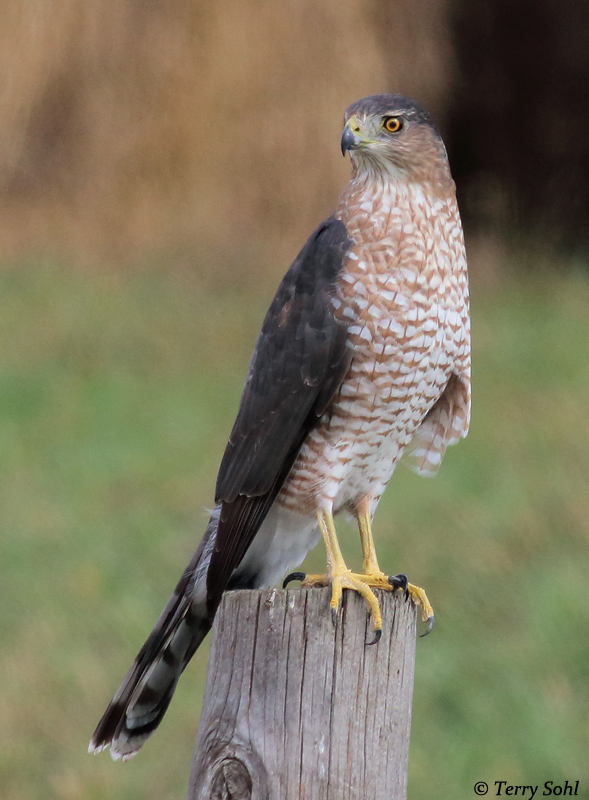
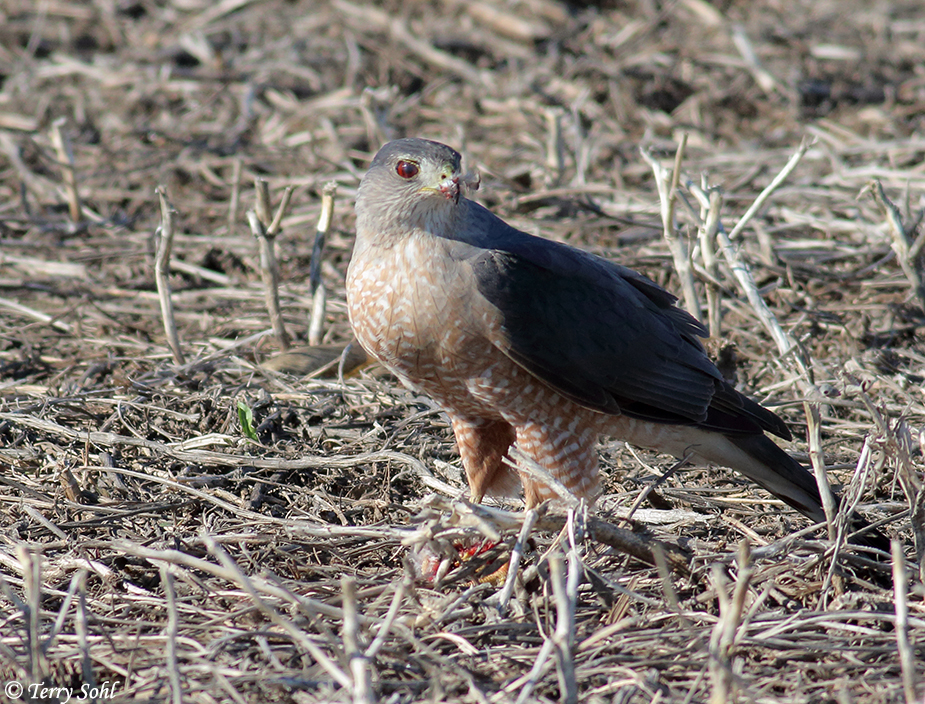
One of the more identification challenges for a birder in North America is differentiating between a Sharp-shinned Hawk and a Cooper's Hawk. Both are very similar in appearance, although there are identification keys that allow identification, if seen well. A juvenile Northern Goshawk could also be mistaken for a Sharp-shinned Hawk, although there's a very substantial size differential. Specific identification keys (and comparison to a Cooper's Hawk) are as follows:
- Size: Sharp-shinned Hawks are typically substantially smaller than a Cooper's Hawk, as they're similar in size to a Blue Jay or a Mourning Dove. When seen (clearly) on their own, the small size of a Sharp-shinned Hawk is often readily apparent and makes it possible to make an ID. However, size can sometimes be difficult to judge, and variation in size between the two species also can make it challenging. For both species, females are substantially larger than males (up to 1/3rd larger). Thus, a female Sharp-shinned Hawk and a male Cooper's Hawk may be relatively close in size. While studies have found only a tiny amount of overlap in size between the largest female Sharp-shinned and the smallest male Cooper's Hawk, it's close enough that in the field, identification by size can be difficult.
- Tail: The best identification
key if size isn't a clear indication of species. Note the tail of the
Sharp-shinned Hawk at the top of the page. The end of the tail is rather
square, as the outside tail feathers on a Sharp-shinned Hawk are almost
as long as the central tail feathers. That results in the squarish
appearance. On a Cooper's hawk, the outside tail feathers are noticeably
shorter than the central tail feathers, with the entire tail as a whole
being more rounded.
Note Cooper's Hawk juveniles also tend to have a distinct white band at the end of the tail, while it's lacking or it's only a very thin band on a Sharp-shinned Hawk. However, this is usually an unreliable identification mark, as feathers get worn as more time passes since moulting. A "fresh" juvenile Cooper's Hawk thus may show a distinct white band, but wearing down of the feather ends may make that much less prominent as time passes. - Head: Sharp-shinned Hawks appear to have a smaller head, in relationship to body size, with a rounded look to it. Cooper's Hawks appear to have a larger, blockier head, that often appears to have a bit of a crest on top, with a noticeable "point" towards the back of the head.
- Eye: The eye of a Sharp-shinned Hawk appears to be more centered on the side of the face than on a Cooper's Hawk, where it often appears to be more "forward" towards the beak. Note eye color is not a good indicator of species, as for both, eyes are typically yellowish when young, trending towards redder and redder as the bird ages.
- Flight: The shape of the bird in flight is often distinctive, if seen well. A Sharp-shinned Hawk often appears to have shorter wings, as when gliding in flight, the wings appear to be held closer to the body, with a distinctive bend and forward thrust of the wing joint. In comparison, a Cooper's Hawk in gliding flight appears to have longer wings that are held out more straight from the body.
 |
 |
 |
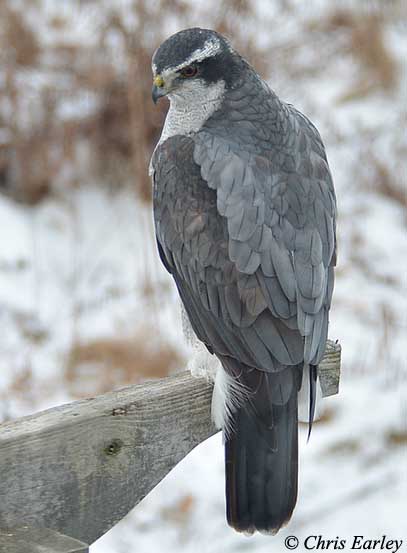 |
| Cooper's Hawk | Cooper's Hawk | Cooper's Hawk | Northern Goshawk |
South Dakota "Hotspot"
Your bird feeder in your backyard! Literally half, if not more, of the sightings of Sharp-shinned Hawks that I've had have been in my backyard near my feeders, or near feeder complexes in other locations. Sharp-shinned Hawks feed almost exclusively on small birds (finches, sparrows, etc.), and the highest concentrations of those birds in winter are often around feeders.
Conservation Status
Numbers declined in the mid 20th century due to effects of pesticides, but began to bounce back by the 1980s. Recent trends again show serious declines in some locations. However, they still have a very wide geographic range, are common in some areas, and are increasing in number in some areas. The IUCN lists the Sharp-shinned Hawk as a species of "Least Concern".
Photo Information
November 18th, 2006 - "Sherriff Dam", southwest of Pierre - Terry L. Sohl
