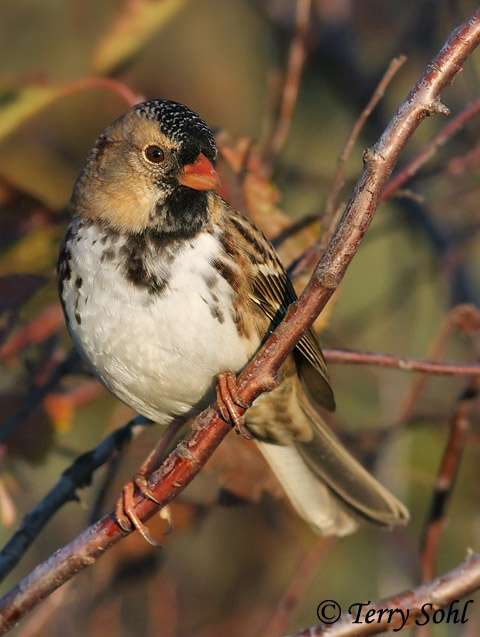
Harris's Sparrows are a very large, beautifully plumaged sparrow species found only in the interior of North America. They were one of the last North American birds to have their nesting location discovered, when nesting Harris's Sparrows were finally seen in the stunted scrubby spruces near the treeline in northern Canada in 1931. They are the only songbird in North America that exclusively breeds within the borders of Canada. They have adapted well to a human presence in North America, and can often be seen on the ground in urban areas, utilizing bird feeders as well as landscaped habitats.
Habitat
The Harris's Sparrow breeds in the stunted spruce forests, willow thickets, and shrubby tundra along the northern tree line of central Canada. During migration and winter, it inhabits brushy fields, hedgerows, woodland edges, shelterbelts, overgrown pastures, and dense shrubby habitats, often near agricultural areas. It prefers locations with thick ground cover and scattered shrubs that provide both foraging opportunities and protection from predators.
Diet
The Harris's Sparrow feeds primarily on seeds, grains, berries, and other plant material during fall and winter. During the breeding season, it also consumes insects, spiders, and other small invertebrates, which provide essential protein for adults and nestlings. It typically forages on the ground, scratching through leaf litter and low vegetation in search of food.
Behavior
The Harris's Sparrow spends much of its time foraging on the ground, scratching through leaf litter and soil for seeds, berries, and insects. It is often seen in loose flocks during migration and winter, commonly associating with other sparrows around brushy habitats, shelterbelts, and backyard feeders.
Nesting
Non-Breeder in South Dakota. In their Canadian breeding habitat, the nest is a cup built of twigs, mosses, and lichens, usually placed on the ground under vegetative cover. The female usually lays between 3 and 5 eggs, and she alone incubates them. When the eggs hatch, both parents help to feed the young. The young leave the nest after about 10 days.
Song
Repeated clear tremulous whistles in 1 pitch, sometimes followed at an interval by several clear notes in another pitch. Calls sound like a loud metallic spink and a drawn-out tseep.
- Click here to hear the song of a Harris's Sparrow1
- Click here to hear the short call notes of a Harris's Sparrow2
Migration
Winters in central to southern Great Plains, summers in remote north-central Canada. In South Dakota they are common migrants, especially in the eastern half of the state. Some birds may occasionally overwinter in the far southern part of South Dakota.
Interactive eBird Map
Click here to access an interactive eBird map of Harris's Sparrow sightings
Similar Species
Generally distinctive, not easily confused with other sparrow species. Their large size, chunky body, plumage patterns, and bill are quite different than any other sparrow species that is found in South Dakota.
Bird Feeders
Harris's Sparrows will attend feeder areas for grains, mixed birdseed, suet, or breadcrumbs. Note Harris's Sparrows typically feed by foraging on the ground, so presentation matters. They will feed directly on a platform feeder. However, for many "typical" feeders they will feed on fallen seeds below the feeder, rather than feed directly from the feeder itself.
Conservation Status
Harris's Sparrows have undergone a slight population decrease in recent decades. Habitat loss and climate change are likely cuases. However, they are still found across a broad geographic area and are relatively common in many parts of their range. The IUCN lists the Harris's Sparrow as a species that is "Near Threatened".
Further Information
- eBird - Harris's Sparrow
- Audubon Field Guide - Harris's Sparrow
- Cornell Lab of Ornithology - All About Birds: Harris's Sparrow
Photo Information
October 8th, 2008 - Minnehaha County, South Dakota - Terry Sohl
Audio File Credits
- 1Ian Cruickshank. Recorded in British Columbia, Canada on April 6th, 2014. Original recording and information from xeno-canto.
- 2Paul Marvin. Recorded in Saunders County, Nebraska on October 10th, 2014. Original recording and information from xeno-canto.
