| Length: 35-38 inches | Wingspan: 70-76 inches | Seasonality: Non-resident in South Dakota |
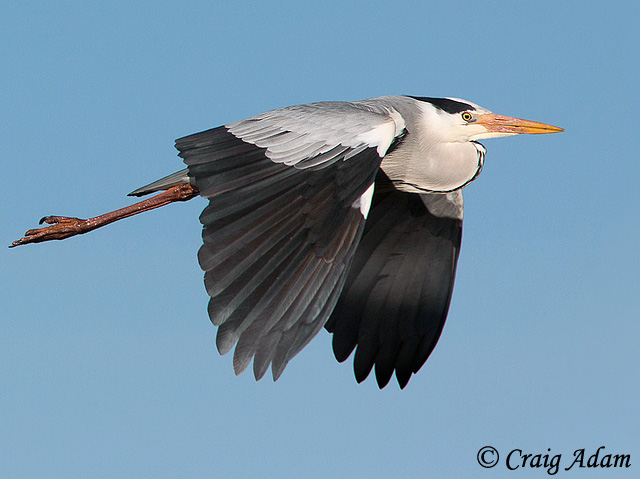
| ID Keys: Gray upperparts, black flight feathers, light underparts, light neck with dark streaks, thick dark stripe behind eye, stout long orangish bill | ||
 The
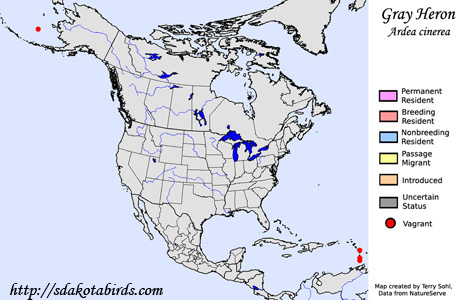
Gray Heron is the Old World counterpart to North America's
Great Blue Heron. Their native
range includes much of Europe, much of Asia except for the far northeast,
and sub-saharan Africa. In North America, they are very rare vagrants,
with most sightings in the southeast Caribbean islands, but also with
sightings in the islands in the Bering Sea off of western Alaska.
The
Gray Heron is the Old World counterpart to North America's
Great Blue Heron. Their native
range includes much of Europe, much of Asia except for the far northeast,
and sub-saharan Africa. In North America, they are very rare vagrants,
with most sightings in the southeast Caribbean islands, but also with
sightings in the islands in the Bering Sea off of western Alaska.
Habitat: Found in a variety of aquatic habitats, including both freshwater and saltwater habitats. May be found in estuaries, tidal flats, and along freshwater rivers and lakes.
Diet: Feeds on a wide variety of creatures, both aquatic and terrestrial. Fish are preferred food item, but they also will feed on amphibians, snakes and other small reptiles, small rodents, crustaceans, mollusks, large insects, and small birds.
Behavior: Usually a relatively passive feeder, standing motionless in shallow water, waiting for prey to approach. When prey is in range, they strike with a thrust of the neck, impaling prey with their bill or grabbing it with their bill.
Nesting: Colonial nester, Gray Herons build large platform nests of sticks or wetland vegetation such as reeds. The nest is usually placed in trees, dense bushes, or thick wetland vegetation, but occasionally on the ground. The female usually lays between 3 and 7 eggs, and both parents help to incubate them. When the eggs hatch, both parents help feed the young, with one parent typically on site at all times to protect the chicks. The young remain in the nest for nearly two months.
Song: Harsh croaking sounds, given in flight, as well as on the nesting grounds.
Migration: In their Eurasian range, birds in the northern part of their breeding range are migratory, while some populations in more temperate and sub-tropical habitats are permanent residents.
Interactive eBird Map: Click here to access an interactive eBird map of Gray Heron sightings
Similar Species: Very similar to North America's Great Blue Heron.
Conservation Status: Populations are relatively large and stable, and they are found over a wide geographic area. The IUCN lists the Gray Heron as a species of "Least Concern".
Further Information: 1) Royal Society for the Protection of Birds - Grey Heron
2) British Trust for Ornithology - Grey Heron
3) BirdLife International - Grey Heron
Photo Information: Photo taken by Craig Adam - September 17th, 2012 - South Africa - Licensed Under Creative Commons Attribution NonCommercial ShareAlike 2.0 Generic License
| Click below for a higher-resolution map |
 |
| South Dakota Status: Non-resident in South Dakota |
Additional Gray Heron Photos (coming soon!!)

ALL PHOTOS COPYRIGHTED. Click below if you have interest in any of these photos for:
| Commercial Use |
| Fine Art Print |
| Personal Usage |
SOUTH DAKOTA BIRDS AND BIRDING - LOCATIONS OF WEBSITE VISITORS
Please mail all comments/suggestions/gripes/complaints to: Dakota Birder
Click here for other references used to compile this page