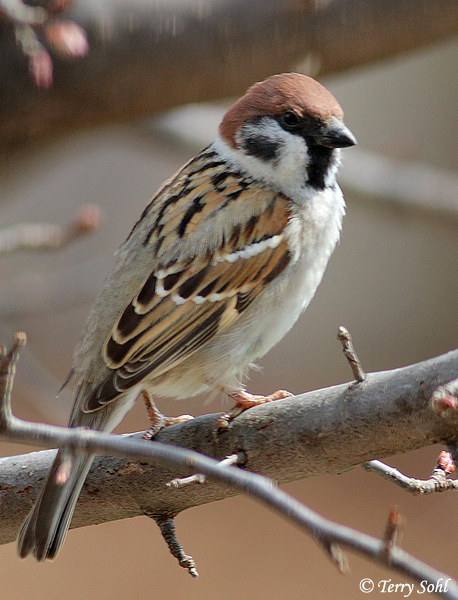
ID Keys: Warm brown crown and nape (male) distinguish it from the
House Sparrow. Black throat, dark cheek patch, light
underparts, reddish-brown upperparst with dark streaking
The
Eurasian Tree Sparrow is indeed a native of Europe and Asia. However,
in 1870, a businessman in St. Louis, Missouri received a shipment of
European birds from Germany, including 2 dozen Eurasian Tree Sparrows.
He released those sparrows in an effort to "enhance" the wildlife in the
region. While they have establish themselves in a small region around
St. Louis and have thrived until the present day, they have not widely
spread, like their introduced relative the House Sparrow. In urban settings they do not compete well with
House Sparrows, and they are more often found in rural settings.
Occasional sightings of the species had been made in Wisconsin over the
years, and a handful of observations were made in Minnesota.
In 2016,
two sightings occurred in the state of North Dakota. However, until April,
2018, the species was unknown in South Dakota, until a lone bird was
observed and photographed at the Gary and Jan Small residence in Vermillion,
South Dakota. Two weeks later, on May 3rd, 2018, two Eurasian Tree Sparrows
were found in Brandon, South Dakota...in my own yard! Recent
research examining Christmas Bird Count data from 1951 through 2014 has
found a statistically significant expansion trend during that time frame,
indicating that after many decades of a very small, stable range around St.
Louis, they may now be increasing in number and expanding their range
northward.
Habitat
The Eurasian Tree Sparrow favors open agricultural landscapes, farmsteads, grassy fields, hedgerows, villages, and suburban areas with scattered trees and nesting cavities. In North America it is most often associated with rural farmland, grain storage areas, parks, and brushy edges near human habitation..
Diet
The Eurasian Tree Sparrow feeds primarily on seeds and grains, including those from grasses, weeds, and agricultural crops. During the breeding season, it also consumes insects and other small invertebrates, which provide important protein for growing nestlings. It commonly forages on the ground in fields, grasslands, farmyards, and around human settlements.
Behavior
The Eurasian Tree Sparrow is a social bird that is often seen in small flocks, especially outside the breeding season. It forages actively on the ground and in low vegetation, searching for seeds, grains, and insects. During the breeding season, it nests in cavities and may form loose colonies where several pairs nest close together.
Nesting
The nest is typically built in a crevice, tree cavity, or other such protected area. It is constructed of grasses, weeds, other vegetative material, and feathers. The female lays between 3 and 6 eggs, and she and the male will both incubate them. The young hatch after about 14 days.
Song
The Eurasian Tree Sparrow gives a series of sharp, dry chip calls that are generally softer and higher-pitched than those of the House Sparrow. Flocks often produce a constant stream of chirping and chattering notes around feeding and nesting sites.
Migration
Considered a permanent resident throughout their normal range.
Most likely to be confused with the House Sparrow. The Eurasian Tree Sparrow is smaller and more neatly patterned than the House Sparrow, with a rich chestnut-brown cap, distinct black cheek spot, and clean white cheeks in both sexes. Unlike House Sparrows, male and female Eurasian Tree Sparrows look alike, and they also show two crisp white wingbars and a smaller black throat patch.
Feeders
Eurasian Tree Sparrows will attend feeders for the standard offered seeds, as well as for suet and fruits.