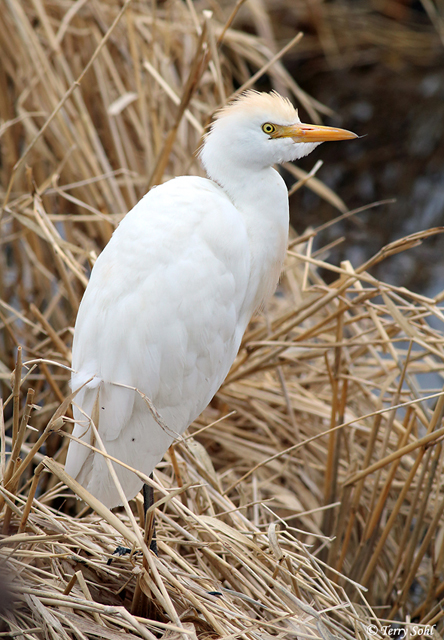
Cattle Egrets are originally native to Africa and the Mediterranean coasts of western Europe. They began to colonize parts of South America in the 1970's, and were first seen in the United States when breeding populations were established in Florida in the early 1940's. Cattle Egrets have since expanding their range to cover much of the southern U.S., and scattered locations throughout much of the northern U.S. Cattle Egrets are unlike other herons and egrets in that they generally feed in upland areas. They often associating with cattle or other livestock, following the animals (or tractors or other farm equipment) and feeding on any insects that are disturbed. Cattle Egrets are often found in mixed breeding colonies with other egrets and herons.
Habitat
The Cattle Egret favors open grassy habitats such as pastures, hayfields, agricultural lands, wetlands, and marsh edges, especially where livestock are present. Unlike many herons and egrets, it often feeds far from water and is commonly seen walking among cattle or other large animals in search of disturbed insects and small prey.
Diet
The Cattle Egret feeds mainly on insects such as grasshoppers, crickets, flies, beetles, and caterpillars that are disturbed by grazing livestock or farm machinery. It also eats frogs, small reptiles, mice, spiders, and other small animals captured while walking through fields and wetlands.
Behavior
Forages in a variety of habitats, but is found in dry, upland habitats much more often than most herons and egrets. Cattle egrets are often found in upland pastures and fields in search of insects.
Nesting
June and July. The next is built on the top branches of a tree or a shrub near water, and is constructed of sticks, with larger sticks supporting the structure and smaller sticks and twigs at the top. Grasses and other vegetative material are sometimes used to line the nest. Both the male and female constructs the nest. Between two and seven eggs are laid, with incubation lasting from 3 to 4 weeks. The young fledge from the nest after about 3 weeks.
Song
Cattle Egrets do have a variety of croaking and grunting calls. Vocalization typically occurs on the breeding grounds, as they are usually silent elsewhere.
1Click here to hear some grunting calls of a Cattle Egret
2Click here to hear a variety of alarm calls from a small group of Cattle Egret
Migration
Summers in scattered locations throughout the United States. Winters near Gulf Coast, the southwestern U.S., and points south.
South Dakota "Hotspot"
Cattle Egrets can often be found around other egrets (Snowy Egret, Great Egret), including sometimes forming mixed breeding colonies. The region around Lake Thompson has always been a hotspot for me (although they're never common). The west side of the lake has everything the birds need, including a large water body with scattered waterside trees for nesting, and some very large cattle operations in the area that attract foraging birds.
Similar Species
Possibly confused with 2 or 3 other "white" egret and heron species.SeeIdentification Tipsfor more information on differentiating between these species.
- Snowy Egret - Structurally, Snowy Egrets are more slender with a much longer neck than a Cattle Egret. Snowy Egrets have a black bill, compared to a yellow bill for a Cattle Egret. Snowy Egrets have the characteristic yellow feet on black legs, while Cattle Egrets have yellowish to reddish legs, dependent upon season.
- Great Egret - Great Egrets are substantially larger than Cattle Egrets, with a more slender build and a much longer neck. Great Egrets appear to have a proportionally smaller head (compared to the body) than a Cattle Egret.
- Little Blue Heron - Immature Little Blue Herons are characterized by completely white plumage and may be confused with a Cattle Egret. However, like Snowy Egrets and Great Egrets, they are structurally more slender with a longer neck than a Cattle Egret. Immature Little Blue Heron also have a two toned bill (grayish and blackish), compared to the yellow bill of a Cattle Egret.
Conservation Status
Populations still increasing and expanding in range. They are common in many parts of their range (including globally), and they are found over an extremely wide geographic area. The IUCN considers the Cattle Egret to be a species of "Least Concern".
Photo Information
May 13th, 2018 -- Weisensee Slough, Minnehaha County, South Dakota -- Terry Sohl
Audio File Credits
1Manuel Schweizer. Recorded near Valencia, Spain on April 8th, 2018. Original recording and information from xeno-canto.
2Stanislas Wroza. Recorded near Marseille, France on May 26th, 2017. Original recording and information from xeno-canto.
Interactive eBird Map
Click to access an interactive eBird species map page for Cattle Egret
