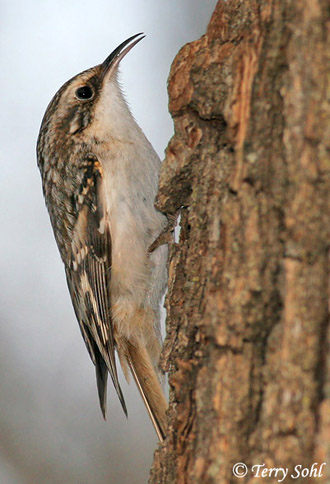
The Brown Creeper is best known for it's very active foraging behavior of flying to the base of a tree, spiraling upwards in search of food, and then flying to the base of another tree to begin the process again. In addition to constantly scouring crevices in tree bark for food, they also build their nests under flaps of loose bark. In the winter, Brown Creepers can often be found in mixed flocks with Chickadees and Nuthatches.
Habitat
Prefers mature forest for breeding, but can be found in parks and residential areas during winter and migration.
Diet
Mostly insects. Will occasionally eat seeds, and will visit feeders in the winter.
Behavior
The vast majority of its foraging is done by climbing on tree trunks or major branches, probing crevices for insects and insect eggs.
Nesting
May through July in South Dakota. Brown Creepers have a unique nesting habit, typically building their nests behind loose flaps of bark that have partially detached from dead or dying trees. These hammock-like structures are constructed from twigs, bark strips, and moss, and are often lined with soft materials like feathers or spiderwebs. This specialized placement provides excellent camouflage and protection from the elements, as the overhanging bark serves as a natural roof for the nest.
Song
The Brown Creeper is known for some of the highest-pitched vocalizations of any North American bird. Because these sounds are at the upper limit of human hearing, they are often described as "thin" or "reedy." Only the male sings, primarily during the breeding season. It is a delicate, tinkling warble that lasts about 1 to 1.5 seconds. Both males and females use calls year-round, especially while spiraling up tree trunks to forage. Calls sounds like a single, piercing "tsee".
Migration
Brown Creepers are permanent residents in much of their normal range in Canada, the Northeast U.S., the Great Lakes area, the Appalachians, and the mountains of the west. Some birds do migrate southward in the winter however, where they also spill out into forested habitats across the U.S.
Interactive eBird Map
Click to access an interactive eBird map of Brown Creeper sightings
Similar Species
Generally distinctive in look and habit, not likely to be confused with other small songbirds.
Bird Feeders
Will attend feeders for suet, peanuts, and peanut butter.
Conservation Status
Due to its preference for mature forest for breeding, they have declined in many parts of their range. Still relatively common and widespread however. The IUCN lists the Brown Creeper as a species of "Least Concern".
Further Information
- eBird - Brown Creeper
- Audubon Field Guide - Brown Creeper
- Cornell Lab of Ornithology - All About Birds: Brown Creeper
Photo Information
November 13th, 2008 - Big Sioux Recreation Area near Brandon, South Dakota.
