
The national bird of the U.S. was seriously endangered by the 1970s due to the effects of DDT and other pesticides. It has made a gradual comeback since DDT was banned, with populations rebounding strongly since the 1970s. In June of 2007, a milestone was reached when the Bald Eagle was officially removed from the Endangered Species list. Bald Eagles can often be found around open water in the winter, including around the Big Sioux River near Sioux Falls, and multiple nesting locations are now found in and around southeastern South Dakota. Overall they've become increasingly common throughout the state, with birds found in many locations, and at all times of the year.
Habitat
Typically near rivers or large lakes. Generally found around water, but can be found in open dry country, particularly during migration. In South Dakota, nesting sites have been established in small riparian areas, shelter belts, and in trees along stock ponds, far from any large water body. They've become increasingly adaptable and can be found in any area where a food source is available.
Diet
Mostly fish when available. When fish are scarce, may eat birds (ducks, coots, others) or mammals (rabbits, muskrats, others). Very opportunistic, often feeds on carrion or steals fish from other birds, such as Osprey.
Behavior
While Bald Eagles will sometimes steal prey items from other birds, or feed on carrion, they also can be powerful hunters.
Nesting
Increasingly common breeder in various parts of the state. The nest of a bald eagle is a massive mound of sticks, built in a tree or on a cliff, or sometimes on the ground on island habitats. The female usually lays 2 eggs, and both parents help to incubate the eggs. When the eggs hatch, both parents help to feed the young, but one parent typically stays with the young for the first 2 weeks. The young fledge at about 11 weeks.
Interactive eBird Map
Click to access an interactive eBird map of Bald Eagle sightings
Song
Both sexes utter gull-like squealing cackle of kleek-kik-ik-ik-ik or lower kak-kak-kak.
1Click here to hear a calling Bald Eagle.
Migrations
Some coastal populations are permanent residents, but birds in the interior of the country are often labeled as being migratory. However, note we have an active nest less than a mile from our home in Brandon, South Dakota, and the pair are found in the general vicinity year-round.
Status
The Bald Eagle has greatly expanded in numbers since the 1970s. They are found across an extremely large geographic area and have become relatively common in some areas even outside of Alaska and Canada. The IUCN now lists the Bald Eagle as a species of "Least Concern".
Similar Species
Juvenile similar to Golden Eagle. Adult unmistakable in most of U.S. range, although rarely the Steller's Sea-Eagle or White-tailed Eagle have been found in North America, and could potentially be confused with a Bald Eagle. The white on those two species is different than that of a Bald Eagle (white shoulder and tail on Steller's Sea Eagle, white only on the tail of a White-tailed Eagle). In South Dakota, the species potentially confused with a Bald Eagle are the following:
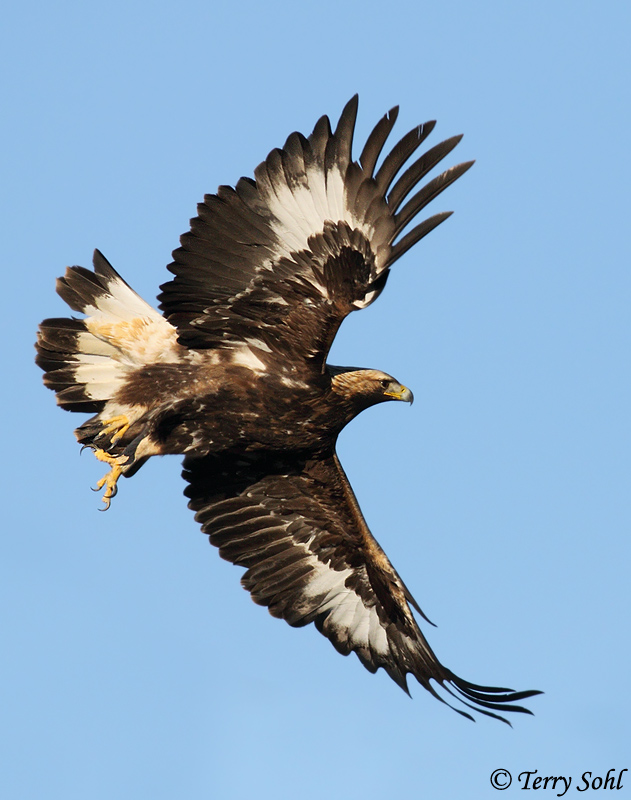
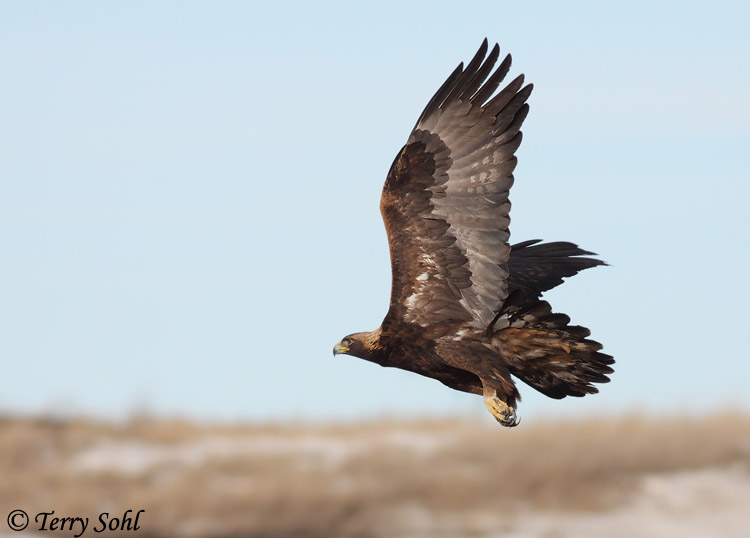
- Golden Eagle - Golden Eagles aren't likely to be confused with a mature Bald Eagle, with the Bald Eagle's white head and tail. However, juvenile Bald Eagles can be confused with a Golden Eagle. Golden Eagles have a golden-toned back of the head that's lacking on a Bald Eagle, but that can be difficult to see in flight or at a distance. In flight, Golden Eagles are all dark, except for slightly lighter flight feathers on an adult, and white spots near the "wrists" and on the rump for a juvenile Golden Eagle. Young Bald Eagles are dark overall but have scattered white mottling on both the tail and wings.
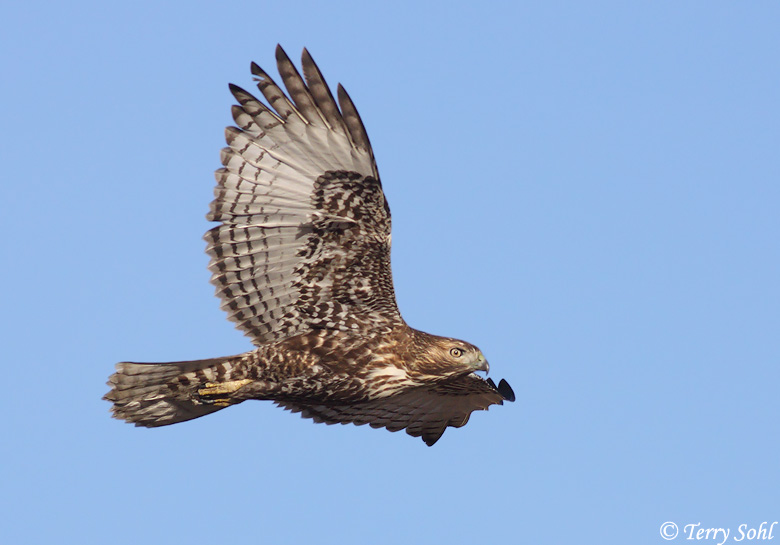
- Red-tailed Hawk - The most common large raptor in South Dakota, Red-tailed Hawks have a very broad variety of plumages, including differences between young birds and adults. Adult Bald Eagles are unlikely to be confused with a Red-tailed Hawk, but younger birds could. Overall, the smaller size and shorter, broader wings differentiate them from Bald Eagles, but both characteristics can be difficult to judge, particularly at a distance. While some color morphs of Red-tailed Hawks are quite dark, even dark-morph Red-tailed Hawks generally appear to have lighter-colored feathering than a young Bald Eagle. Dark morph Red-tailed Hawks ("Harlan's Hawks") also have a clear distinction between dark inner wings and light flight feathers, while young Bald Eagles have a much more haphazard, mottled appearance.
- Turkey Vulture - One more large "raptor", the nearly all dark Turkey Vulture could be confused with a young Bald Eagle at a distance. Even at a distance they can be differentiated from a young Bald Eagle, however, with dark inner wings contrasting strongly with light flight feathers, and a head that looks much smaller than that of a Bald Eagle.
 |
 |
 |
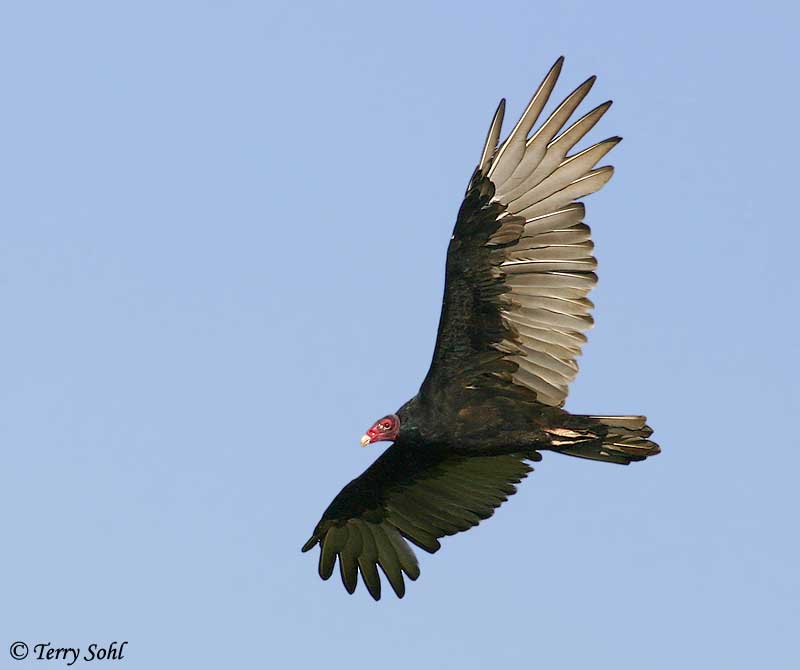 |
| Golden Eagle (young) | Golden Eagle (mature) | Red-tailed Hawk | Turkey Vulture |
South Dakota "Hotspot"
Winter time below the Missouri River dams is great for finding concentrations of Bald Eagles. Directly below Gavin's Point Dam has always been great for me. You can see them pretty much anywhere in the vicinity of the dam, but they do seem to like to roost in the trees on the Nebraska side of the river.
The Missouri River is far from the only location where Bald Eagles can be found. Even around the biggest city in the state (Sioux Falls), there are now multiple nests along the Big Sioux River, with birds staying in the area all year long. When I go birding in the central part of the state in winter to look for raptors, there are often many Bald Eagles, and there are also nesting sites that have become established since 2010 in areas far away from any large water body. In short, Bald Eagles have become a species that you wouldn't be surprised to see in any part of the state, at any time, although heavier concentrations are found in the areas noted here.
Further Information
- eBird - Bald Eagle
- Audubon Field Guide - Bald Eagle
- Cornell Lab of Ornithology - All About Birds: Bald Eagle
Photo Information
December 15th, 2002 -- Below Gavins Point Dam -- Terry L. Sohl
Audio File Credit
1Paul Marvin, XC451490. Accessible at www.xeno-canto.org/451490
