| Length: 12 inches | Wingspan: 31 inches | Seasonality: Extremely rare visitor |
| ID Keys: Extremely short legs, small thin dark red bill in breeding plumage, black bill for juveniles and nonbreeding, black cap, uniform pale gray primaries | ||
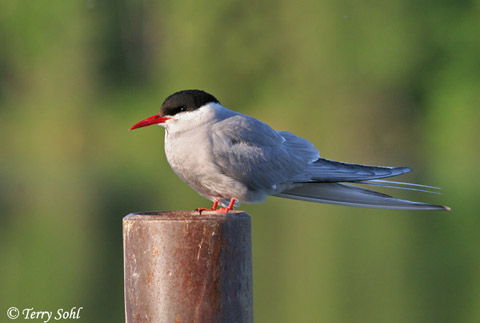 Arctic
Terns may be the longest migrating birds on the planet, with some birds
summering in the Arctic, and wintering in the Antarctic. They breed
throughout the Arctic and as far south as northern New England, but are only
very rare stragglers inland, including South Dakota. There are only a
pair of records at this time, both since 1999 at Oahe Dam near Pierre.
Arctic
Terns may be the longest migrating birds on the planet, with some birds
summering in the Arctic, and wintering in the Antarctic. They breed
throughout the Arctic and as far south as northern New England, but are only
very rare stragglers inland, including South Dakota. There are only a
pair of records at this time, both since 1999 at Oahe Dam near Pierre.
Habitat: Arctic Terns nest on coastal tundra, rocky beaches, and islands along the coast, as well as near inland water bodies in the Arctic. During migration and winter, they are primarily pelagic birds, most often found over cold water well offshore.
Diet: A variety of items, including many small fish, crustaceans, marine worms, mollusks, and insects.
Behavior: Primarily feeds while in slow flight, plunging into the water when prey items are spotted. They are also capable of catching insects in mid-air, and will sometimes dip to the water's surface to scoop up prey on the wing.
Breeding: Non-breeder in South Dakota.
Interactive eBird Map: Click to access an interactive eBird map of Arctic Tern sightings
Song: A wide variety of high-pitched, harsh calls, similar to Common Terns but typically higher in pitch.
Migration: Summers throughout the Arctic, and along coastlines as far south as northern New England in North America. In migration, primarily migrates well offshore, spending migration and winter months on the open ocean. Very seldom seen from land in North America except on its breeding grounds.
Similar Species: Common Tern, Forster's Tern
Conservation Status: Most of its breeding grounds are minimally affected by human activity, and overall there appears to be no population trend. However, they are declining as a breeding species in some southern parts of their breeding range, including in North America.
Further Information: 1) USGS Patuxent Bird Identification InfoCenter - Arctic Tern
2) Cornell University's "All About Birds" - Arctic Tern
3) Arctic Tern Migration Project
Photo Information: June 25th, 2006 - Near Anchorage, Alaska - Terry Sohl
Additional Photos: Click on the image chips or text links below for additional, higher-resolution Arctic Tern photos.
| Click on the map below for a higher-resolution view |
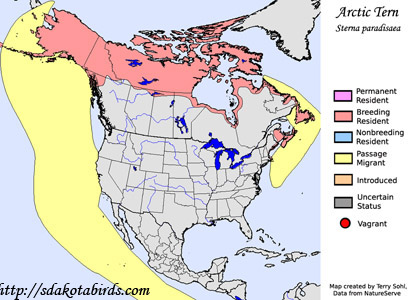 |
| South Dakota Status: Only a handful of records in the state, with sightings primarily at Oahe Dam near Pierre. |
Additional Arctic Tern Photos
Click for a higher-resolution version of these photos

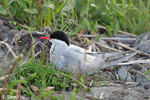


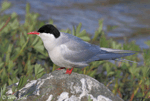






ALL PHOTOS COPYRIGHTED. Click below if you have interest in any of these photos for:
| Commercial Use |
| Fine Art Print |
| Personal Usage |
SOUTH DAKOTA BIRDS AND BIRDING - LOCATIONS OF WEBSITE VISITORS
Please mail all comments/suggestions/gripes/complaints to: Dakota Birder
Click here for other references used to compile this page