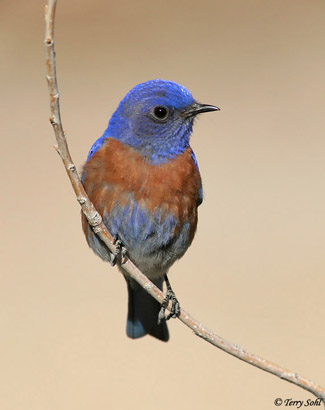
Western Bluebirds
are found in open and semi-open habitats in the western United States.
They are most easily distinguished from Eastern
Bluebirds by range and by their blue throat (compared to rusty orange on an Eastern
Bluebird). Their normal range is a few hundred miles from South
Dakota, and they are considered only very rare visitors to the state.
Habitat
Found
in semi-open and open habitats in all seasons, such as open pine and oak
woodlands, riparian bands of trees, pinyon-juniper woodlands, and farmland.
Diet
Insects
make up the majority of the diet, but berries and fruits can also be an
important food item, especially in the winter when insects aren't as plentiful.
Behavior
Often
feeds by perching low in vegetation and swooping down to the ground to snatch
insects. They will also fly from a perch to catch insects in mid-air, and
will forage among the foliage.
Breeding
Non-breeder in South Dakota
Song
Short sweet warbling.
Migration
Summers throughout
the Northwest and Southwest U.S., extreme southwestern Canada, and in
Mexico. Those in the northwestern part of their range migrate southward
for the winter, but the rest are generally permanent residents.
Numbers strongly declined over much of their
range in the 20th century due to loss of natural nesting sites and competition
with other songbirds (including introduced species such as
European Starlings).
However, they appear to be rebounding and increasing in number over the last
couple of decades. The
IUCN considers the Western Bluebird to be a species of "Least Concern".
Photo Information
May 1st, 2008 - Zion National Park, Utah - Terry Sohl