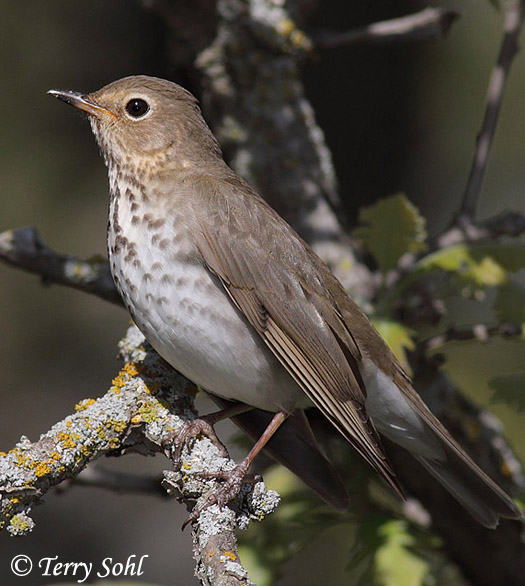
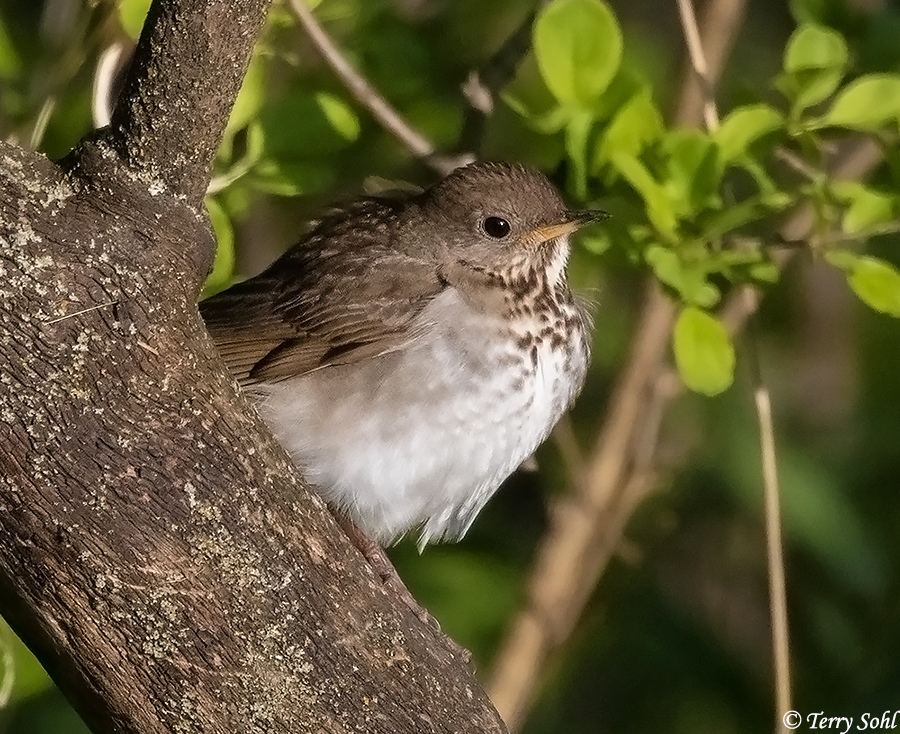
A common migrant through the state, Swainson's Thrushes are often found in mixed flocks with other similar thrushes. They can be confused with species such as Hermit Thrush, although the warm rusty rump of a Hermit Thrush is a clear differentiating feature. Gray-cheeked Thrushes are the species most similar in appearance, and the subtle plumage differences can sometimes make them difficult to differentiate. However, Gray-cheeked Thrushes are generally much less common than Swainson's Thrushes, and while Swainson's Thrushes do breed in the Black Hills of South Dakota, Gray-cheeked Thrushes are only migrants in the state. Generally a shy bird, Swainson's Thrushes are often considered a difficult bird to observe. In South Dakota, that's generally true for breeding birds in the higher elevations of the Black Hills, but in migration, they can often be found cautiously foraging in open grassy areas adjacent to woodland edges, flitting back into cover when disturbed.
Habitat
Nearly any kind of wooded habitat during migration and in the winter. During this time of year they are often found along woodland edges, foraging in adjacent open areas but using the woodland itself for cover and roosting. They use conifer forests for breeding throughout most of their normal range, although they will use deciduous forest in a few breeding locations in North America. They prefer forests with a dense understory, as nesting is primarily done in small shrubs and sapling of the understory.
Diet
Mostly insects, earthworms, and other invertebrates. However, during migration they will also sometimes feed on fruits and berries.
Behavior
Often foraging on the ground, walking or hopping a short distance, pausing and looking, before moving on again. Also forages quite often in the foliage and branches of trees and shrubs, and may occasionally fly out from an observation perch to capture passing insects in mid-air.
Nesting
June and July. The nest is a cup built of a variety of vegetative material including twigs, dead leaves, grasses, weed stems, and strips of bark, lined with finer twigs, rootlets, and mosses. The female alone builds the nest, placing it on a branch of a small tree or bush in conifer forest areas with a healthy understory. She lays 2 to 5 eggs, and she alone incubates them. The young hatch after 12-14 days, and fledge from the nest 10-14 days after hatching.
Song
The song consists of a series of sweet, musical phrases, high-pitched but with different tones for each note.
- Click here to hear the song of a Swainson's Thrush1
- Click here to hear the call of a Swainson's Thrush2
- Click here to hear the harsh alarm calls of a Swainson's Thrush in response to a nearby owl3
Migration
Summers throughout much of Canada, the Great Lakes region, the Northeastern U.S., and much of the Western U.S. Winters in southern Mexico and points south.
Interactive eBird map
Click here to access an interactive map of Swainson'sThrush sightings
Similar Species
There are a number of Thrush species similar in appearance to the Swainson's Thrush that either migrate through the state, or are summer breeding residents. Here are the species most likely to be confused with a Swainson's Thrush.
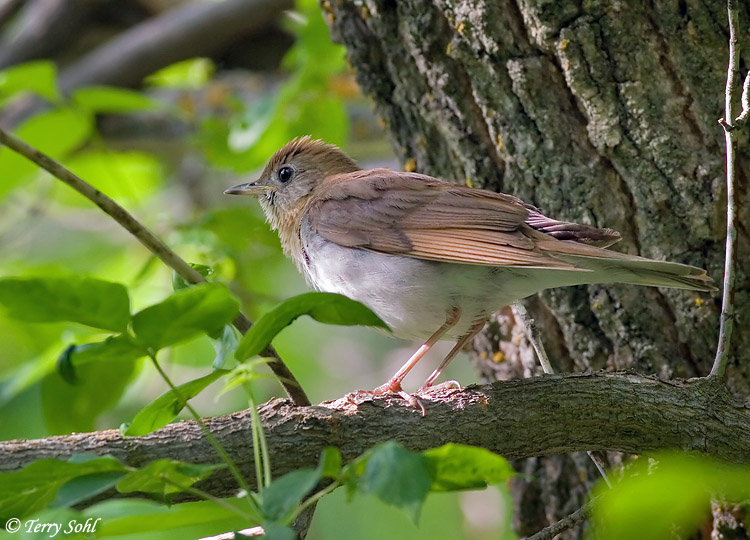
- Veery - Veery are migrants through most of the state, although some do breed in the Black Hills and in the extreme northeastern corner of the state. Veery have a rich, rusty-brown appearance overall, compared to the duller grayish-brown of a Swainson's Thrush. They also have much less extensive spotting on their underside.
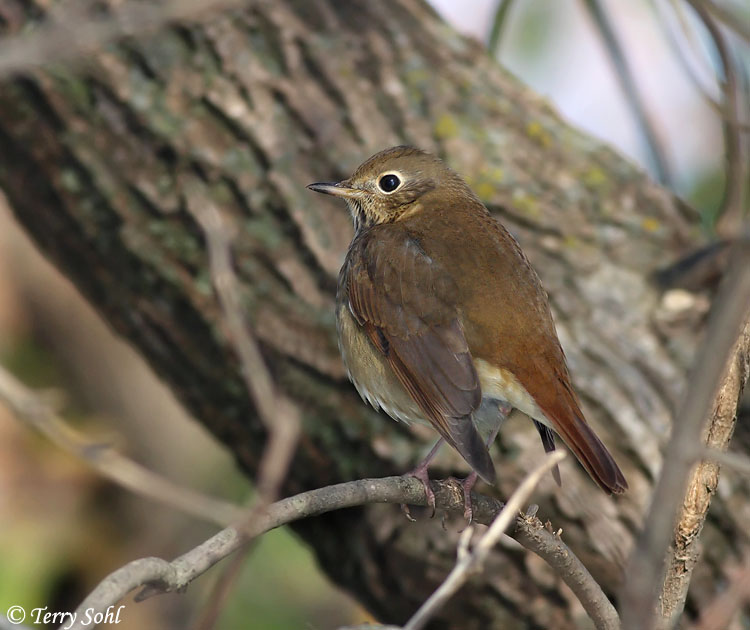
- Hermit Thrush - Hermit Thrush are a migrant in South Dakota. They are known for their rusty-colored rump that contrasts with duller brown on the rest of the body. Swainson's Thrush are more uniformly grayish-brown on their upperparts.
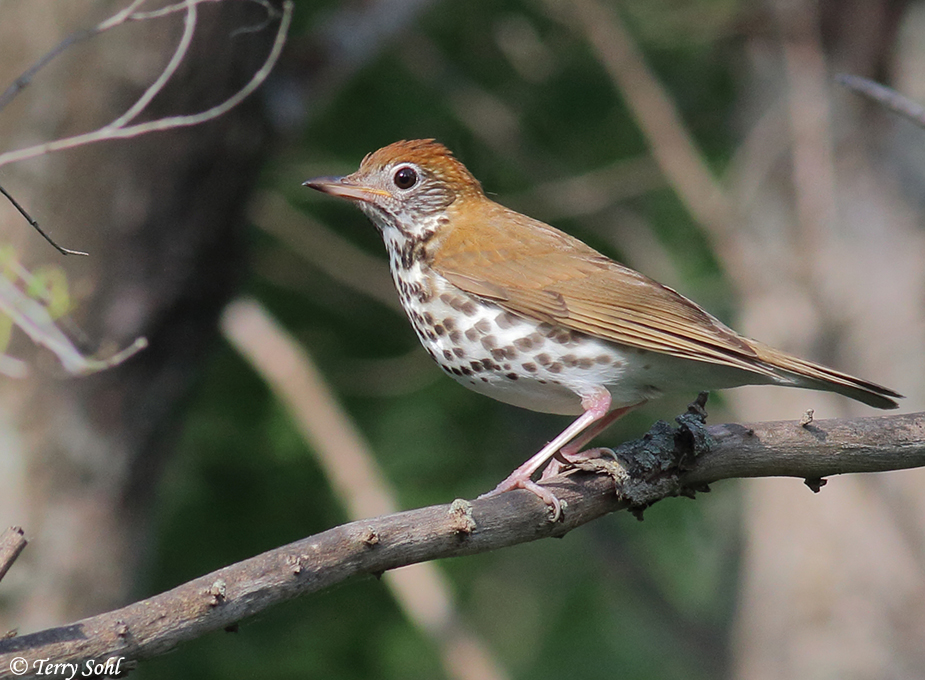
- Wood Thrush - Wood Thrush are a summer breeding bird in the far southeastern part of the state, and locally elsewhere. They are a richer, rusty brown overall than the grayish-brown Swainson's Thrush. The spots on a Wood Thrush are distinct, bold, and dark, while those on a Swainson's Thrush are more muddied. Wood Thrush are very white on their underparts, while a Swainson's Thrush has is very slightly gray.
- Gray-cheeked Thrush. Gray-cheeked Thrush is the species most similar in appearance. The eyering on a Swainson's Thrush is typically buffy and more prominent than the whiter, weaker eyering of a Gray-cheeked Thrush. Gray-cheeked Thrushes also lack the buffy tones on the cheek and upper breast that are generally found on Swainson's Thrushes.
 |
 |
 |
 |
| Veery | Hermit Thrush | Wood Thrush | Gray-cheeked Thrush |
South Dakota "Hotspot"
During the spring migration in the first two-thirds of May, Swainson's Thrushes are typically quite easy to find in appropriate habitat. During that time of year it's more about timing and appropriate habitat than it is about one specific "hotspot". They prefer being around woodland edges, but with open grassy areas to forage in at this time of year. Because of those habits, state parks in the eastern part of the state are good places to find Swainson's Thrushes, as they will often forage in the open, managed grassy areas that about riparian forest and other woodlands that are often found in eastern state parks. During the summer months, they also can be found as breeding birds in higher elevations of the Black Hills, but they are not as easy to observe on their breeding grounds as they are in migration.
Feeders
Not a species that normally attends feeders, during migration they will occasionally stop for offered fruits.
Conservation Status
There is evidence of declining populations in recent decades, but overall populations are strong, and they are found across a wide geographic area. The IUCN considers the Swainson's Thrush to be a species of "Least Concern".
Photo Information
May 17th, 2011 - Minnehaha County, South Dakota - Terry Sohl
Audio File Credits
- 1Simon Elliott. Recorded in British Columbia on July 11th, 2003. Original recording and information available from xeno-canto.
- 2Simon Elliott. Recorded in British Columbia on July 19th, 2003. Original recording and information available from xeno-canto.
- 3James Link. Recorded in Jefferson County, Washington on July 24th, 2020. Original recording and information available from xeno-canto.
