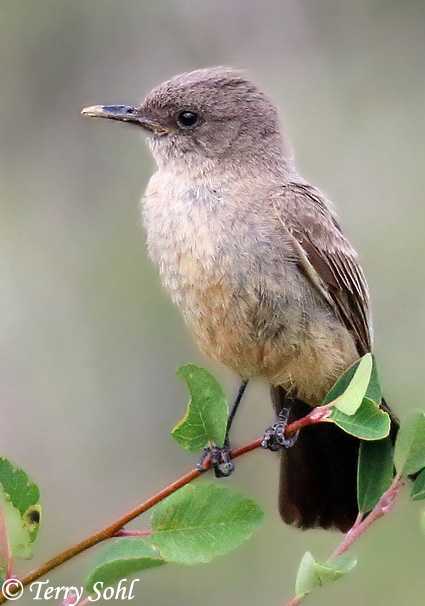
Say's Phoebe is a phoebe of drier habitats in the western part of the U.S, and are primarily found in the western half of South Dakota. They have an extremely broad breeding range, from Mexico to Alaska, breeding further north than any other flycatcher species in North America. They will often nest on and around farm buildings in the western part of the state. They can often be seen on the highest perch in a particular area, keeping an eye out for insects. Where a suitable perch is absent, they will also hover as they forage.
Habitat
Prefers open terrain such as prairies, rangeland, farmland, and canyons. They will also use human structures for nesting.
Diet
Almost exclusively insects, rarely berries. Has the lovely habit of coughing up indigestible insect parts.
Behavior
Typical flycatcher behavior when foraging...observing from a perch, and flying out to catch insects when they are spotted.
Nesting
May through July. The nest of a Say's Phoebe is a cup constructed of pieces of roots, bark, leaves, twigs, and grasses, with a lined inner cup of finer materials such as grass, moss, spiders webs, or animal hair. The nest is built on a ledge partially protected from the elements above, which can be a cliff face, the wall of a cave, or a man made structure like a bridge or a building. The female lays between 3 and 7 eggs, and she alone incubates them. The young hatch after about 2 weeks, and fledge from the nest another 2 weeks after hatching.
Song
The song of a Say's Phoebe is a descending, slurred whistling note.
1Click here to hear the song of a Say's Phoebe
2Click here to hear another version of a Say's Phoebe song
Migration
Summers in Western U.S., Canada, and Alaska. Winters in the southwestern U.S., Mexico, and Central America.
Interactive eBird map
Click here to access an interactive eBird map of Say's Phoebe sightings
Similar Species
Potentially confused with other flycatcher species
- Eastern Phoebe - The range of the Eastern Phoebe and Say's Phoebe do overlap in South Dakota, leading to a potential for misidentification. Eastern Phoebes have paler underparts and typically a stronger contrast between the darker upperparts and lighter underparts. Eastern Phoebes are mostly white below, while a Say's Phoebe has a grey breast and a buffy-colored belly.
- Vermilion Flycatcher - Female Vermilion Flycatchers are perhaps the most similar bird to a Say's Phoebe, but they are but extremely rare visitors to South Dakota. Where both species are found, the Vermilion Flycatcher is differentiated from Say's Phoebe by it's smaller size and reddish belly, compared to the buffy-colored belly on the Say's Phoebe.
Conservation Status
Generally stable or potentially increasing in some areas. They have learned to adapt to human presence, and now often nest in residential areas. They are found across a broad geographic area and are common in parts of their range. The IUCN considers Say's Phoebe to be a species of "Least Concern".
Photo Information
May 2nd, 2008 - Bryce Canyon, Utah - Terry Sohl
Audio File Credits
1Frank Lambert - Recorded in Pima County, Arizona on April 14th, 2018. Original recording and information from xeno-canto.
2Bruce Lagerquist - Recorded in Yakima County, Washington on April 3rd, 2016. Original recording and information from xeno-canto.
