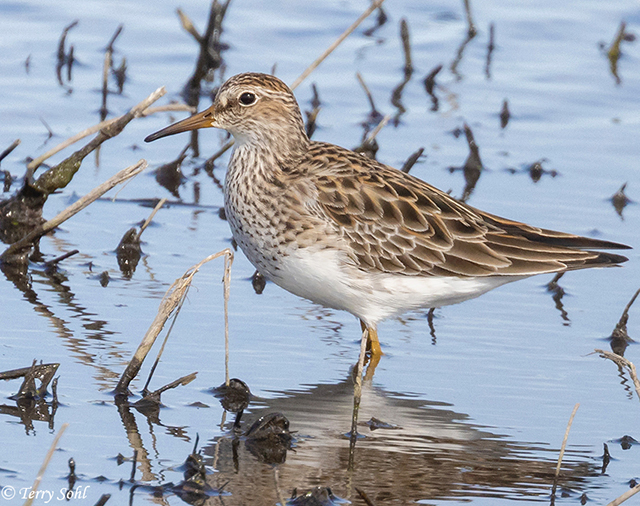
The name of a Pectoral Sandpiper refers to an inflatable air sac the male uses in it's courtship display. Pectoral Sandpipers do have an important field identification characteristic in a sharp abrupt contrast between the streaks of the upper breast and the white of the belly. For shorebirds that migrate through South Dakota, they can also be identified by their unique combination of 1) yellow legs, and 2) a two-toned bill with yellow at the base and darker towards the end. They can most often be seen in very shallow flooded pastures and grassy mudflats.
Habitat
Flooded pastures, muddy shorelines, shallow ponds. Prefers areas with some grass/emergent vegetation rather than open mudflats.
Diet
Mostly insects, also small crustaceans, seeds, and spiders.
Behavior
Forages in shallow water, mudflats with vegetation, or wet meadows. Uses its bill to probe in the mud, or plucks food items from the ground, foliage, or water's surface.
Breeding
Non-breeder in South Dakota. On their breeding range, Pectoral Sandpipers construct a cup-shaped nest on the ground, built of grasses and leaves. The female lays three to five eggs, and she alone incubates them. The young hatch after about 3 weeks.
Song
Low churrrt, krrrek, or tik-tik-tik vocalizations. The male uses it's inflatable air sac to vocalize during courtship displays, with a variety of individual vocalizations made in series.
- Click here to hear the complex song of a Pectoral Sandpiper, recorded on the North Slope of Alaska.1
- Click here to hear the gurgling call of a Pectoral Sandpiper, recorded on the North Slope of Alaska.2
- Click here to hear the calls of a small group of Pectoral Sandpipers, recorded in Quitman County, Mississippi.3
Migration
Summers in extreme northern Canada, winters in South America
Interactive eBird Map
Click here for an interactive eBird map of Pectoral Sandpiper sightings
Similar Species
With a combination of moderate size (for a shorebird in South Dakota), yellow legs, bill coloration and shape, and sharp demarcation between breast markings and a clean white belly, Pectoral Sandpipers are relatively easy to differentiate from other shorebirds in the state. However, they could potentially be confused with the following species:
- Ruff - The species most similar to Pectoral Sandpiper is one that's only a rare visitor to North America, as the Ruff is primarily an Eurasian species. It's the female or non-breeding plumaged juvenile that could perhaps be confused with a Pectoral Sandpiper, as they share somewhat similar coloration and yellow legs. However, the Ruff is larger, and they do not possess the sharp demarcation between marked breast and white belly that is found on the Pectoral Sandpiper.
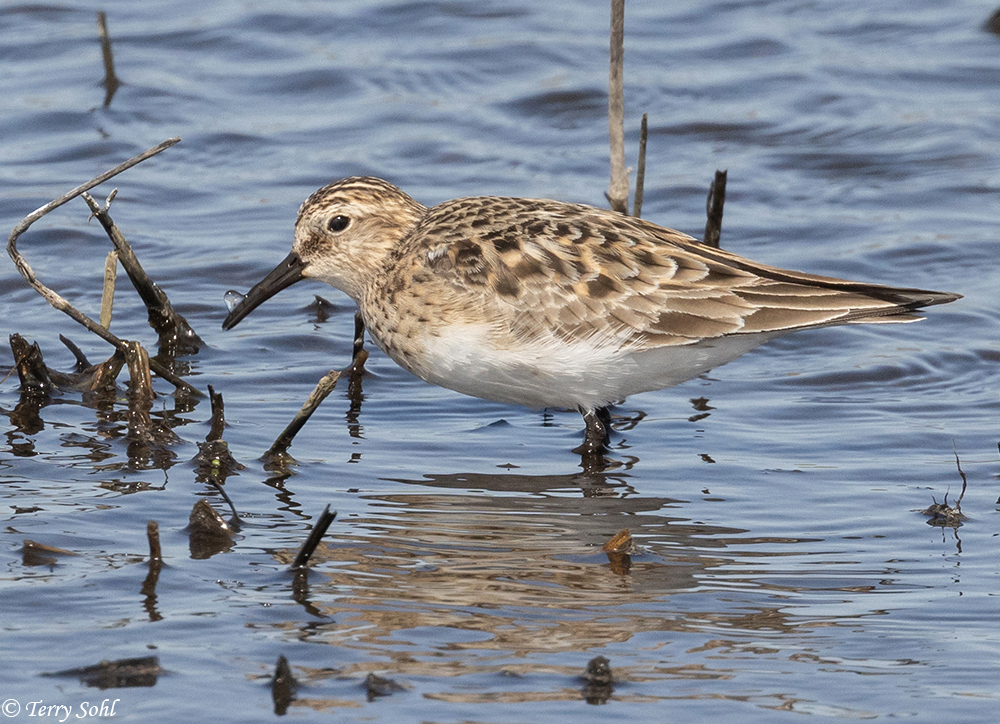
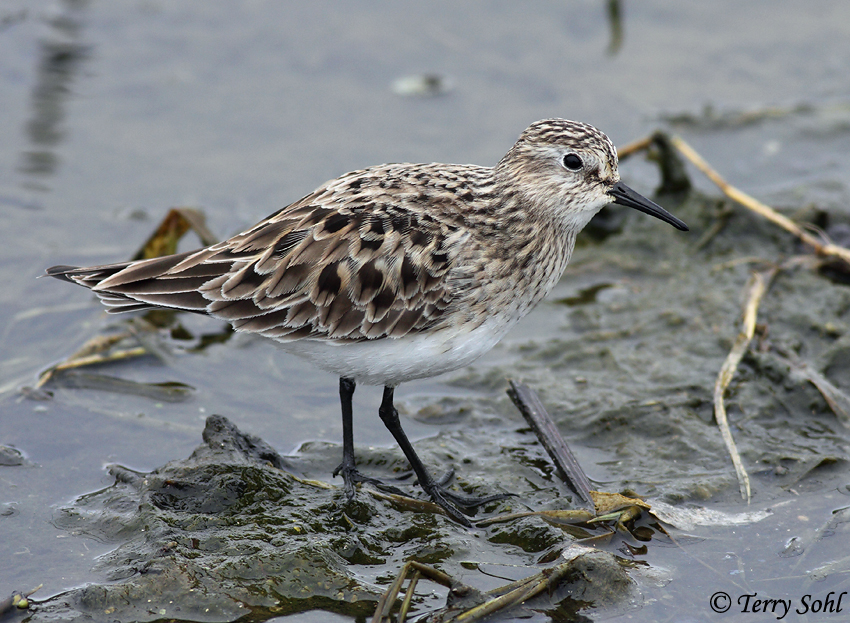
- Baird's Sandpiper - Baird's Sandpiper share a similar coloration, and even have a fairly distinct demarcation between marked breast and clean belly. However, Baird's Sandpipers are smaller, the demarcation isn't as clean as on a Pectoral Sandpiper, and both the legs and bill of a Baird's Sandpiper are uniformly dark (Pectoral Sandpipers have yellow legs and coloring at the base of the bill).
- Stilt Sandpiper - Non-breeding Stilt Sandpipers migrating through in the fall could perhaps be confused with a Pectoral Sandpiper, as both share the same general plumage patterns. However, the bill of a Stilt Sandpiper is noticeably longer, and the distinction between marked breast and clean underbelly isn't nearly as distinct as on a Pectoral Sandpiper.
 |
 |
 |
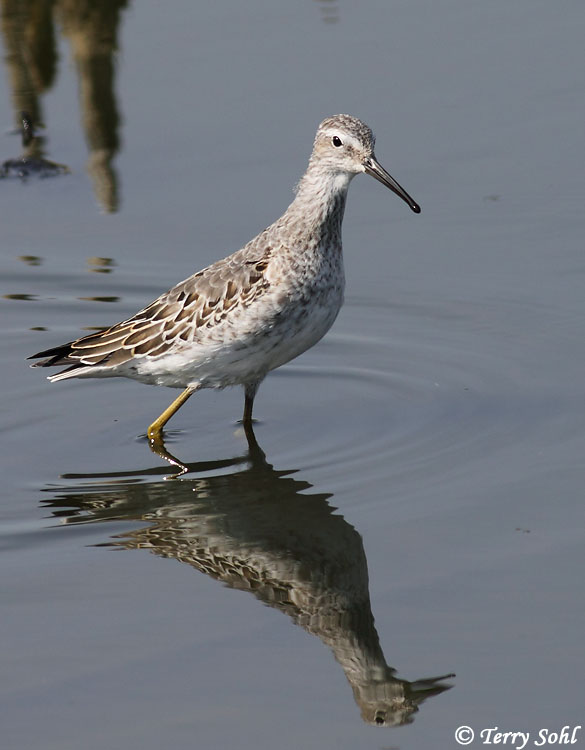 |
| Baird's Sandpiper | Baird's Sandpiper | Stilt Sandpiper | Stilt Sandpiper |
Conservation Status
Numbers are generally stable throughout its range, populations overall are large, and they are found across a broad geographic area. The IUCN considers the Pectoral Sandpiper to be a species of "Least Concern".
Photo Information
May 14th, 2004 -- Madison Waterfowl Production Area -- Terry Sohl
Audio File Credits
- 1Jarmo Pirhonen, XC426277. Accessible at www.xeno-canto.org/426277.
- 2Peter Boesman, XC323082. Accessible at www.xeno-canto.org/323082
- 3J.R. Rigby, XC308705. Accessible at www.xeno-canto.org/308705
