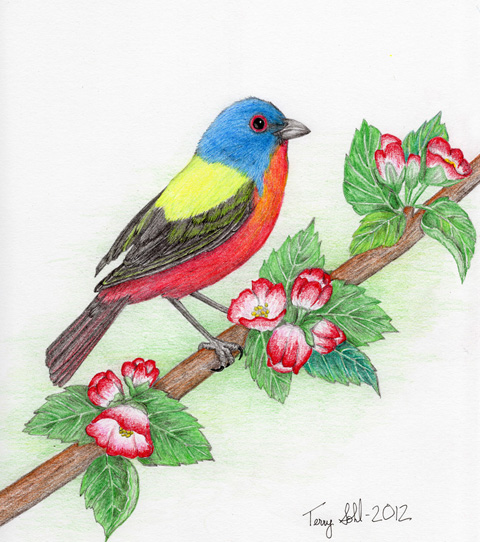
ID Keys: Male unmistakable, with red underparts, blue head, and lime-green
patch on back.
Perhaps
the most colorful of all North American songbirds, the Painted Bunting is
normally a bird of the southeastern U.S., and only occasionally strays north
of its normal range. The "Birds of South Dakota" (SDOU -- 2002) lists
only one sighting of the species in the state. They are typically
birds of brushy undergrowth, and can sometimes be difficult to observe.
Males of the species are known for their intense physical fights over
territory and mating rights, fights which sometimes even end in the death of
one of the combatants.
Habitat
Prefers semi-open country with thick ground cover, such as thickets, brushy fields, hedgerows, woodland clearings and edges, and forest undergrowth.
Diet
Feeds primarily on seeds and insects.
Behavior
Primarily forages on the ground, although they will also forage low in bushes or trees. Males will sing from higher perches, although they are often obscured by foliage when doing so.
Breeding
Non-breeder in South Dakota
Song
Sweet warbling
Migration
In the United States, normally only found in the southeastern U.S. through Texas in the summer.. Winters in southern Florida, the Caribbean, Mexico, and Central America.
Interactive eBird map
Click here to access an interactive eBird map of Painted Bunting sightings
Similar Species
Distinctive plumage on males, unlikely to confuse with other species. Similar in structure to Varied bunting , Indigo Bunting
Bird Feeders
Will attend feeders for sunflower and other seeds. Will also make use of bird baths.
Conservation Status
Generally stable through most of its range.
Image Information
Colored pencil drawing by Terry Sohl - January 2012