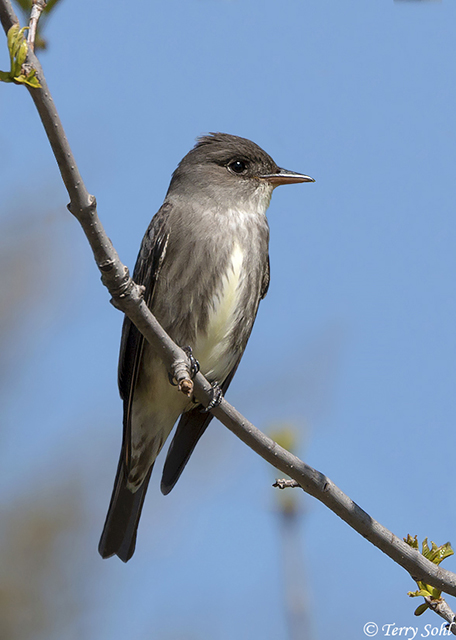
The Olive-sided Flycatcher is a dapper flycatcher species most known for it's "vested" appearance, with a clear contrast between a dark vest and lighter belly. They are most often observed perching high in the tree tops, giving out an occasional pip-pip call and flying out to capture flying insects. While they are generally reclusive and solitary, they will vigorously defend their nesting location from intruders.
Habitat
Primarily found in conifer forests, especially near clearings along burned areas, rivers and lakes, and wetlands. The habitats they're found in typically have a mix of tall live trees and some scattered dead trees, the latter of which often serve as perches used for their clear lines of sight as they scan for flying insects.
Diet
Feeds almost exclusively on flying insects, especially bees, wasps, winged ants, and items as large as cicadas and large beetles. It is thought they may also feed on some fruits and berries in migration or in winter, particularly if insect prey is scarce.
Behavior
Olive-sided Flycatchers nearly always catches insects in flight, observing from a high perch and flying out to capture flying insects passing by. They are very territorial, even for one of the "tyrant" flycatcher species. They will aggressively defend very large territories during the nesting season, but they also defend territories on their wintering grounds. They tend to be rather anti-social compared to many other songbirds, rarely being found in numbers beyond single birds or bonded pairs.
Breeding
There are no definite records of breeding within South Dakota, but there have been several breeding season observations in the Black Hills (see "Birds of South Dakota", SDOU, 2002). Olive-sided Flycatchers build a cup-shaped nest in a tree, anywhere from 10 feet to over 100 feet above the ground. The nest itself is constructed of twigs, grasses, and roots, lined with finer grasses, conifer needles, mosses, and lichen. The female lays 3 or 4 eggs, and she alone incubates them. The young hatch after about 2 weeks, and fledge from the nest about 2 weeks after hatching.
Song
The song of an Olive-sided Flycatcher is often described as "quick three beers", with the second note higher. The most commonly heard call is a quick pik, often given in short series.
- Click here to hear the song of an Olive-sided Flycatcher1
- Click here to hear mixed calls and songs of an Olive-sided Flycatcher2
- Click here to hear the calls of an Olive-sided Flycatcher3
Migration
Summers throughout much of the southern half of Canada, the upper Great Lakes, New England, and in higher elevations and near the coast in the western United States. Primarily winters in South America, with a few in Central America.
Interactive eBird Map
Click here to access an interactive eBird map of Olive-sided Flycatcher sightings
Similar Species
Olive-sided Flycatchers could be confused with other flycatcher species that either migrate through the state, or are summer breeding residents:
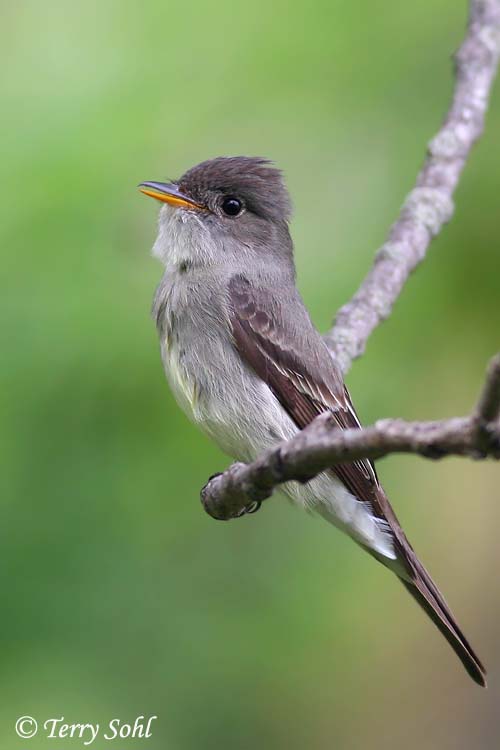
- Eastern Wood Pewee - Eastern Wood-pewees are a common summer resident in forests of eastern South Dakota, and could easily be in the same habitats as Olive-sided Flycatchers. Habit may be one way to differentiate between the two species, as Eastern Wood-pewees tend to perch and forage lower in the forest canopy than Olive-sided Flycatchers, who are often found perched on the tallest tree in a given area. In terms of appearance, the very strong "vest" appearance of a Olive-sided flycatcher distinguishes it from the Eastern Wood-pewee, who still has a faint vest appearance. Eastern Wood-pewees have a smaller and less robust bill than an Olive-sided Flycatcher as well.
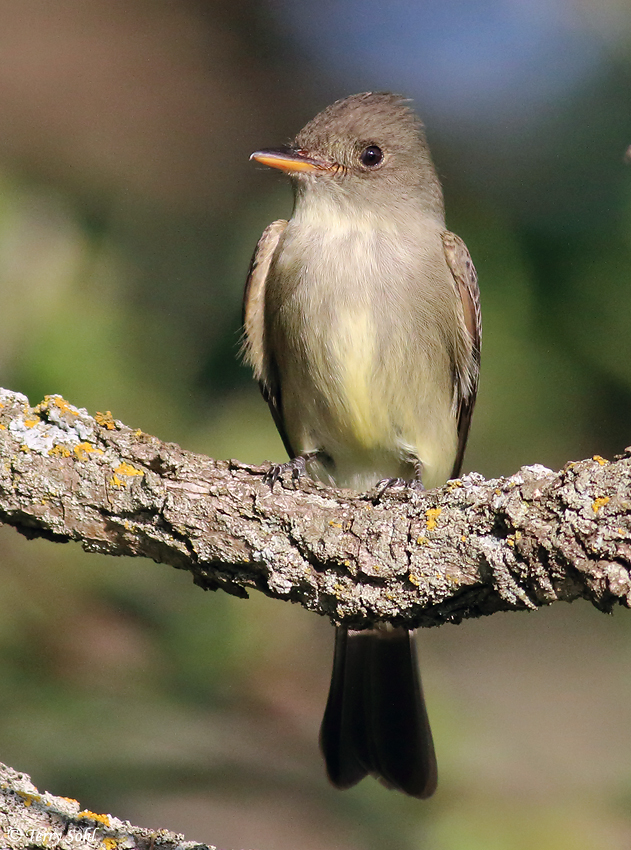
- Western Wood Pewee - Western Wood-pewees are the western US's ecological equivalent of the Eastern Wood-pewee, and they are virtually indistinguishable from Eastern Wood-pewees in appearance. The same identification keys for Eastern Wood-pewee thus apply to Western Wood-pewee, when differentiating from Olive-sided Flycatcher.
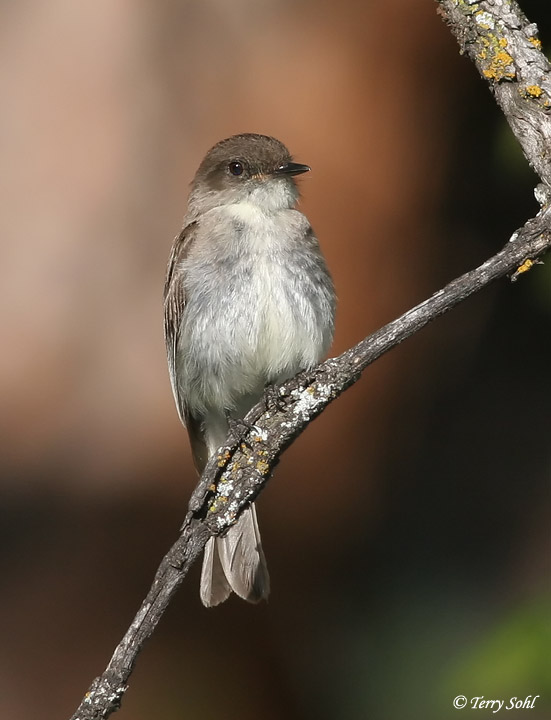
- Eastern Phoebe - Eastern Phoebes are another rather common summer flycatcher in much of South Dakota. They prefer semi-open habitats and are far less likely to perch on high tree tops as Olive-sided Flycatchers often do. They're smaller than Olive-sided Flycatchers, and have a much cleaner, uniform appearance on their underside.
 |
 |
 |
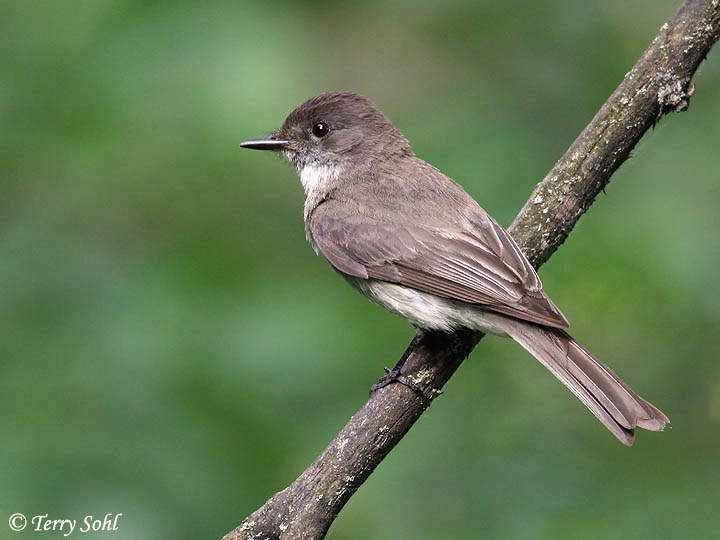 |
| Eastern Wood-pewee | Eastern Wood-pewee | Western Wood-pewee | Eastern Phoebe |
Conservation Status
Olive-sided Flycatchers have shown very severe decreases in population over the last several decades, a pace of decrease which may have increased in the last 20 years. This may be due to loss of habitat in its wintering grounds in South America. Breeding Bird Survey data indicate losses may be as high as a 75% decline in numbers over the last 40 years. While they're still found across a broad geographic area, the high population declines have the IUCN considering the Olive-sided Flycatcher to be a "Near Threatened" species.
Photo Information
May 12th, 2019 - Outdoor Campus in Sioux Falls -- Terry Sohl
Audio File Credits
- 1"Sunny". Recorded near Vancouver, Canada on July 20th, 2019. Original recording and information available from xeno-canto.
- 2Lelis Navarrette. Recorded in Ecuador in 1996. Original recording and information available from xeno-canto.
- 3Richard E. Webster. Recorded in Cochise County, Arizona on May 17th, 2015. Original recording and information available from xeno-canto.
