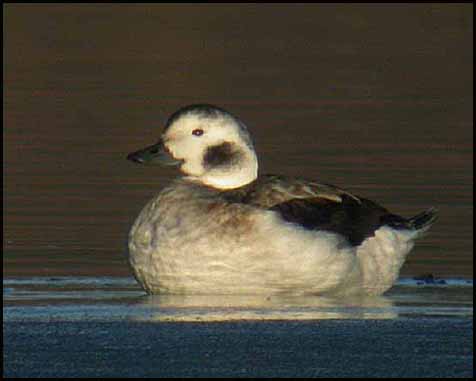
ID Keys: Extremely long tail on male. Plumages very different in
summer and winter, but both with a short black bill with pinkish
ring near the tip.
The Long-tailed Duck is primarily a bird of cold near-Arctic waters, where they are often the most common bird. They were
formerly called Oldsquaw, a reference to their very noisy and talkative behavior
(a name changed for reasons of political correctness). A
winter-plumaged female is shown in the photo on the right. Only the males have the extremely long
tail feathers.
Habitat
In
breeding season, they are found on low-lying tundra, barren ground in and around
the treeline in the Arctic, other areas with open water nearby. In
migration and winter, they are primarily found on the ocean, and also some on
the Great Lakes and other large inland fresh water bodies.
Diet
Primarily feeds on
mollusks and crustaceans at sea, as well as a few small fish. In summer
breeding season, feeds heavily on aquatic insects, as well as crustaceans,
mollusks, fish and amphibian eggs, and plant material.
Behavior
Capable of diving deeper than most
ducks, Long-tailed Ducks feed by diving underwater and propelling themselves
with their feet.
Breeding
Non-breeder in South Dakota
Song
Very loud ow-ow-owdle-ow
calls that can be heard from up to a mile away.
Migration
Summers throughout much of northern
North America. Winters along both the Pacific and Atlantic coasts of
North America, usually from the northern half of the U.S. on northward.
Due to long
tail length, superficially similar to Northern
Pintail. However, the species is generally
distinctive.
Conservation Status
Still abundant through most of their normal range.
South Dakota "Hotspot"
As they're only rare
visitors to the state, there's no real "hotspot", but the majority of
sightings have been along the Missouri River, especially below the major
reservoir dams.
Photo Information
November 11th, 2003 -- Lake Yankton below Gavin's Point Dam -- Terry L. Sohl