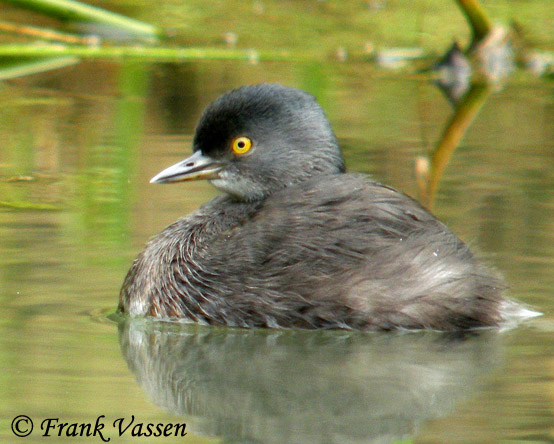
ID Keys: Tiny size for a grebe, dark gray overall, yellow eye, black
face, dark bill
The
Least Grebe is the smallest of the Grebe species in North America.
They have a very wide distribution in the Western Hemisphere, as they are
found in much of South America, Central America, Mexico, and the Caribbean.
Their range barely crosses into the United States, in southern Texas.
Habitat
Can be found in a variety of wetland
habitats, especially those with signficant vegetation at the water's edge.
Diet
Feeds on a variety of small animal life,
including small fish, salamanders, frogs, snails, and insects.
Behavior
Mostly feeds by diving underwater,
chasing prey while swimming in dives of up to 20 or more seconds. They
will also pick up prey items from the water's surface, or pluck insects and
snails from wetland vegetation.
Nesting
Least Grebes will nest at almost any
season. They build a floating nest made out of aquatic vegetation,
anchored to reeds or other wetland vegetation. Both parents will
incubate the eggs, and help tend to the young.
Song
Loud nasal, single-note tone
Migration
Considered a permanent resident
throughout their normal range.
Least Grebes have a
widespread range, and are fairly common throughout much of that range.
They are considered a species of "Least Concern" by the IUCN.