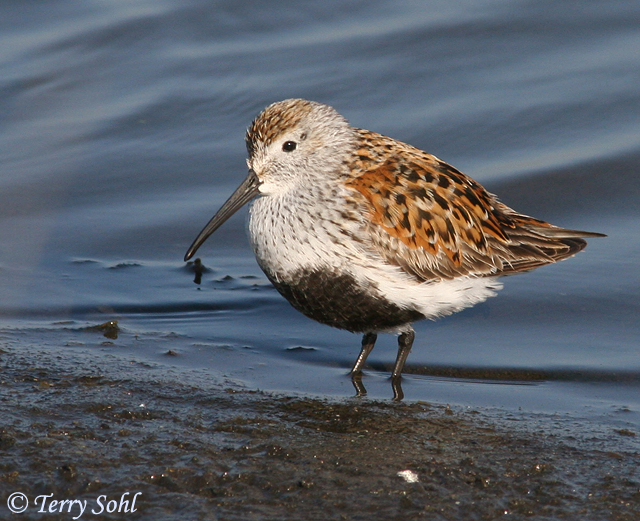
Vast differences are obvious in winter and breeding plumages, as the Dunlin sports a ruddy brown back, white underparts, and black belly patch in the spring, but has a very nondescript grayish plumage in the winter. Dunlins generally tolerate colder weather better than many other shorebirds, migrating southward relatively late in the fall and often overwintering as far north as New England or the coast of Alaska. In South Dakota, they are relatively common migrants in the spring, but are rare in the fall, primarily because Dunlins move to the coastlines of North America for the winter.
Habitat
The Dunlin inhabits Arctic tundra during the breeding season, especially wet coastal tundra, sedge meadows, marshy lowlands, and areas near ponds and shallow wetlands. During migration and winter, it frequents tidal mudflats, estuaries, salt marshes, beaches, coastal lagoons, sewage ponds, flooded fields, and shallow inland wetlands where it can probe soft mud for food.
Diet
Primarily insects and insect larvae on migration through the state. Also small mollusks and crustaceans, small fish, and some plant material.
Behavior
The Dunlin is a highly social shorebird that often occurs in large flocks during migration and winter. It forages actively by probing mud and shallow water with its slightly downcurved bill, frequently moving in tight groups that wheel and turn in unison when disturbed. During migration, flocks may contain hundreds or even thousands of birds feeding together on mudflats, wetlands, and coastal shorelines.
Breeding
Non-breeder in South Dakota. In breeding range, the nest of a Dunlin is a scrape on the ground lined with grasses and leaves, usually placed in a hidden area such as next to a clump of grass or small hummock. The female lays between 2 and 4 eggs, and both parents help to incubate them. When the eggs hatch, the young quickly leave the nest and find their own food, with the parents helping to protect them. The female however usually leaves after a few days, leaving the male to tend to the young. The young fledge after about 3 weeks.
Song
The "song" of a Dunlin is a raspy zheeep, generally repeated a number of times. They have similarly raspy calls given as contact calls or flight calls, but often with just a single note.
1Click here to hear the flight calls/song of a Dunlin, recorded in far eastern Russia.
2Click here to hear the alarm / flight calls of a Dunlin, recorded in Mississippi.
Migration
Summers in northern Canada and Alaska. Winters along North American coastlines. They migrate both along coastlines and the interior, but are much more common as interior migrants during the spring (including in South Dakota).
Interactive eBird Map
Click here to access an interactive eBird map of Dunlin sightings
Similar Species
Breeding plumage Dunlin are distinctive, with the trademark black belly. However, in other plumages they could potentially be confused with the following (focusing on species potentially found in South Dakota) in non-breeding plumage. It's less of an issue in the fall, as Dunlin are not nearly as common fall migrants as spring migrants in the state. However, some shorebirds moving through in the spring (particularly early spring) have yet to acquire full breeding plumage.
- Sanderling - Sanderlings in non-breeding plumage share the same general structure and grayish plumage. However, Dunlins have a longer bill with the slight droop, are darker gray overall, and have some grayish coloring on the upper breast (generally white in a non-breeding Sanderling).
- Western Sandpiper - Not a common migrant in South Dakota, but similar in non-breeding plumage. However, Western Sandpipers are considerably smaller, and have a noticeably shorter and straighter bill.
- Semipalmated Sandpiper - A much more common migrant than Western Sandpiper, and similar to Dunlin in non-breeding plumage. But again, they are considerably smaller, and have a noticeably shorter and straighter bill.
- Baird's Sandpiper - Perhaps the most likely to be confused with a Dunlin if both are in non-breeding plumage. Baird's Sandpipers share a slightly drooping bill (but shorter and thinner than a Dunlin). Baird's Sandpipers are larger and generally have some buffy wash on the upper breast.
Conservation Status
Numbers have seemingly declined since the 1970's. Multiple monitoring programs indicate that several North American populations are in long-term decline, prompting its designation as a shorebird of moderate conservation concern. Principal threats include loss and degradation of coastal mudflat wintering habitat, disturbance and contamination in migratory stopover areas, and growing climate-related changes across its Arctic breeding grounds. The IUCN lists the Dunlin as a species that is "near threatened".
Photo Information
May 20th, 2005 -- Wetland near Wentworth -- Terry L. Sohl
Audio File Credits
1Jens Kirkeby, XC385669. Accessible at www.xeno-canto.org/385669
2Hal Mitchell, XC316123. Accessible at www.xeno-canto.org/316123
