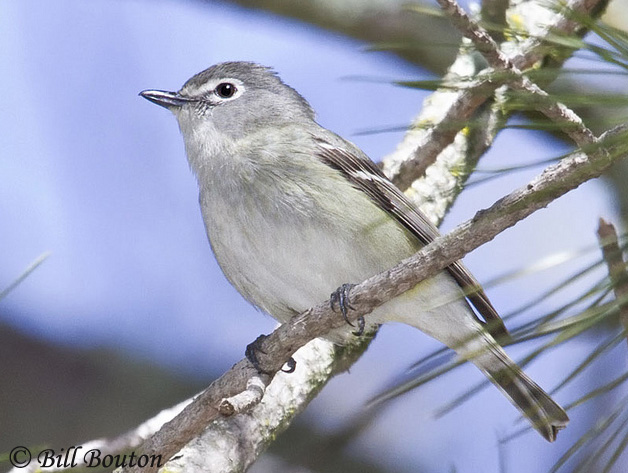
The Cassin's Vireo was, until recently, considered one species (the "Solitary Vireo), along with the Blue-headed Vireo and the Plumbeous Vireo. The plumage of a Cassin's Vireo is somewhat intermediate between the more boldly colored Blue-headed Vireo, and the drabber Plumbeous Vireo. Each of the three species differ in their primary range and geography can be used to help identify which of the three species is sighted, but the Cassin's and Plumbeous Vireos do have some overlap in range in the West, making differentiation of the two species more difficult.
Habitat
Found in open woodlands in western North America in the summer, most often in oak woodlands in the south or dry conifer forests towards the north. Can be found in a variety of woodland habitats during migration.
Diet
During the summer months, feeds almost exclusively on insects and spiders. In winter, they may augment their diet with some fruits and berries as well.
Behavior
Forages deliberately in the mid- to high-levels of the forest canopy, searching through the foliage and branches for insects. They will also sometimes fly out to capture insects in mid-air.
Nesting
The nest of a Cassin's Vireo is a cup of grasses, weeds, roots, plant down, and other fibers, placed on the branch of a tree, between 5 and 30 feet from the ground. The female lays 3 to 5 eggs, and both parents help to incubate them. Upon hatching, both parents tend to and feed the young.
Song
The song of a Cassin's Vireo is a series of whistled phrases, increasing in pitch and then descending. Also has a harsh call note.
Migration
Birds that summer in the western U.S. and Canada move southward to Mexico for the winter, with some found as far north as southern California and Arizona.
Similar Species
Plumbeous Vireo , Blue-headed Vireo. The Cassin's Vireo, Plumbeous Vireo, and Blue-headed Vireo form the well-known "Solitary Vireo" complex and can be challenging to separate, especially during migration.
Cassin's Vireo is typically intermediate between the other two species. It usually shows a gray head with a slight olive wash on the back and flanks, creating a somewhat softer contrast between the head and body. The white spectacles are present but generally less crisp than on a Blue-headed Vireo.
Plumbeous Vireo is the grayest of the three. It often appears clean gray from head through upperparts with little or no olive or green coloration. The contrast between its gray head and white throat is often sharp, and the bird can appear rather plain and cold-toned overall.
Blue-headed Vireo is the most colorful and contrasting. It typically shows a blue-gray head, bright olive-green back, yellow-green flanks, and bold white spectacles. The strong contrast between the head and back is often the quickest field mark.
Range can be very helpful.
- Cassin's Vireo breeds primarily in the Pacific Coast states, the Great Basin, and portions of the western interior.
- Plumbeous Vireo breeds mainly in the Rocky Mountains, the Southwest, and adjacent western forests.
- Blue-headed Vireo breeds across eastern and northeastern North America and is the species most likely to be encountered in much of the eastern United States.
In South Dakota, Blue-headed Vireo is generally the most expected member of the group during migration, while Cassin's and especially Plumbeous Vireos are much rarer and often require careful documentation. Vocalizations are often the most reliable way to separate them on the breeding grounds, but during migration observers typically rely on overall coloration, contrast, and range expectations.
Conservation Status
The Cassin's Vireo is generally considered a species of low conservation concern, with populations remaining relatively stable across much of its western North American range. The species occupies a variety of woodland and forest-edge habitats and has shown resilience in many areas. However, local populations can be affected by habitat loss, forest fragmentation, intensive wildfire, and changes in woodland structure. Overall, Cassin's Vireo remains widespread and secure throughout most of its breeding range. The IUCN lists the Cassin's Vireo as a species of "Least Concern" .
Photo Information
Photo taken on May 2nd, 2012 by Bill Bouton , in San Luis Obispo County, California - Photo licensed under Creative Commons Attribution ShareAlike 2.0 Generic License
Interactive eBird Map
Click to access the interactive eBird species sightings page for Cassin's Vireo
