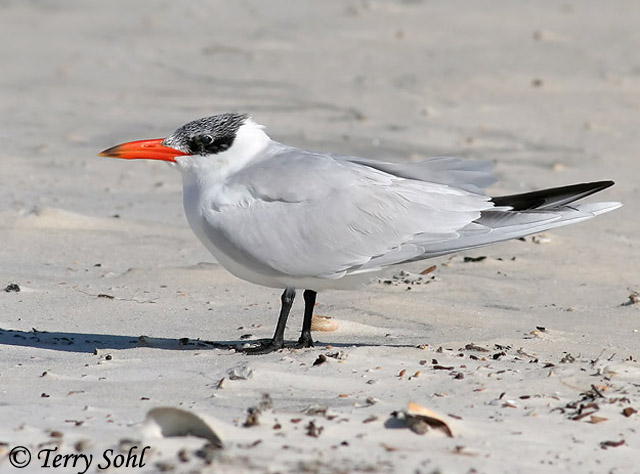
Caspian Terns are the only large terns likely to be seen on inland waters, including within South Dakota. Less sociable than many terns, they are often seen singly or in small groups. Known for their aggressive feeding tactics, Caspian Terns won't hesitate to steal a catch from another bird, or raid a nesting colony for eggs and young birds. Young of the species are dependent upon their parents for a much longer period of time than most other terns and gulls, and can still be seen begging parents for food in mid-winter.
Habitat
Prefers large expanses of water, including coastlines, large lakes, reservoirs, and large rivers.
Diet
Primarily feeds on fish. They often focus on just one or two primary prey species, which vary from location to location. They will also feed on large insects, eggs and young birds, and occasionally crustaceans or mollusks.
Behavior
Feeds by plunging into the water for prey after spotting it in flight. Very aggressive, they will often steal food from other bird species.
Nesting
June and July. The nest of a Caspian Tern is a shallow depression on the ground, sometimes lined with bits of vegetation or debris. The female usually lays between 1 and 3 eggs, and both parents help to incubate them. When the eggs hatch, both parents help to feed the y oung. Young fledge after about a month, but typically stay with the parents for several months after fledging.
Breeding Map
Only a very rare breeder in South Dakota. Breeding Bird Survey map unavailable.
Song
Caspian Tern Song
Migration
Summers along coastlines and in widely scattered inland locations throughout Canada and the United States. Inland birds move to coastlines in the winter, and wintering birds can be found southward through northern South America.
Similar Species
In South Dakota, somewhat similar to Common Tern and Forster's Tern , but large size and heavy bill make it quite distinctive. Ini other parts of its range, most likely to be confused with Royal Tern .
Conservation Status
Numbers are generally stable, with some indications that it is increasing in both range and in numbers. The IUCN lists the Caspian Tern as a species of "Least Concern".
Photo Information
February 13th, 2008 - Bon Secour National Wildlife Refuge, Alabama - Terry Sohl
Interactive eBird Map
Click to access the eBird species page for Caspian Tern
