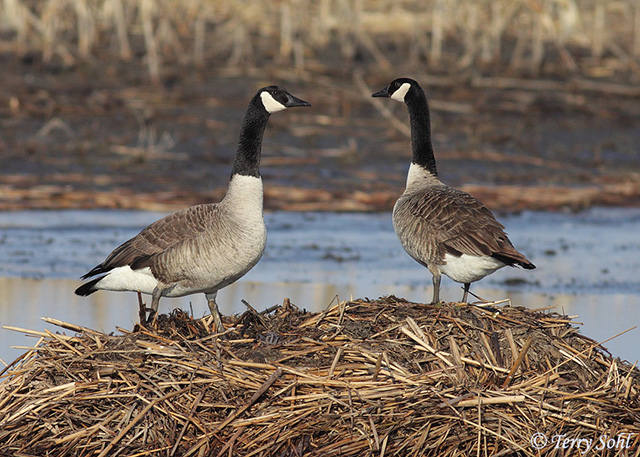
Canada Geese are a species that has adapted well to human presence, becoming a common resident of city parks and water bodies. Canada geese do migrate, but might be found wherever open water exists in the winter. There's a huge disparity in size between the smallest and largest races of Canada Geese. The smallest of what were once considered a small race of Canada Goose is now considered its own species, the Cackling Goose.
Habitat
The Canada Goose inhabits a wide variety of wetlands and open landscapes including lakes, ponds, rivers, marshes, reservoirs, grasslands, agricultural fields, parks, and golf courses. It prefers areas with open water for safety and nearby grassy feeding areas, and many populations have adapted well to urban and suburban environments.
Diet
Primarily plant material such as grasses, aquatic plants, seeds, and berries. Can rely quite heavily on waste grain during winter months. Also eats some insects, small fish, and crustaceans.
Behavior
Forages both on land and on water. In water, swims on the surface, submerging its head and neck to obtain food. Walks on land while foraging, and has learned to use agricultural fields for foraging.
Nesting
Late March through late May. The nest of a Canada Goose is large bowl-shaped structure of grasses, sedges, sticks, and moss, lined with down. It may be placed in a variety of locations depending on setting. The female usually lays between 4 and 7 eggs, and she incubates them. The young only stay in the nest for a day or two after hatching before being led into the water by the parents. The young feed themselves, but the parents tend them and vigorously protect them. The young fledge after about 8 weeks.
Song
A familiar honking sound, which may very in pitch and tone.
- Click here to hear the honking calls of a Canada Goose1
- Click here to hear a group of calling Canada Geese in flight2
- Click here to hear the hissing of an adult (and the peeping of the young its protecting)3
Migration
Birds summering in Canada migrate south, but populations in the U.S. may or may not migrate depending on local circumstance. They will overwinter if open water is available. In South Dakota, they are found all year around, although they are clearly less numerous in the heart of winter. However, very large numbers may congregate in areas of open water.
eBird Sightings Map
Click to access an interactive eBird map of Canada Goose sightings
Similar Species
- Cackling Goose - Cackling Geese and Canada Geese used to be considered the same species. Plumage patterns are very much the same as a Canada Goose, but there are key structural differences that make them unique. Cackling Geese are usually substantially smaller than a Canada Goose, but size isn't a perfect discriminator because Canada Geese themselves have a broad range of sizes. Other structural differences are diagnostic. Cackling Geese have a shorter neck, a shorter bill, and a smaller looking head with a steeper forehead than on a Canada Goose. Sometimes Cackling Geese have a thin white band on the lower throat that separates the black neck from the body.
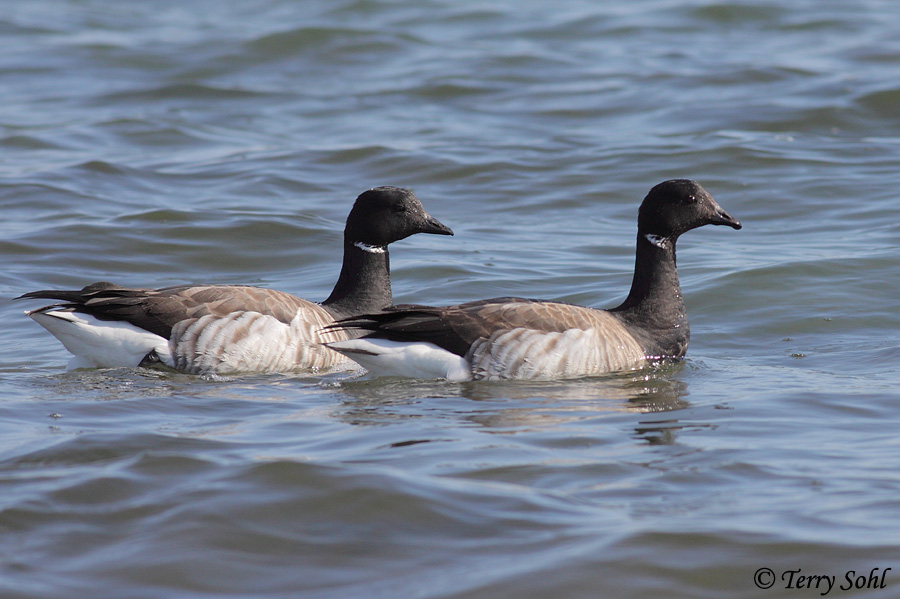
- Brant - Brant are normally a bird of the far northern Arctic in the summer months, and a bird of the North American Coastlines in winter. They only rarely are found in the interior of the continent and so are a quite rare visitor to South Dakota. In appearance, they're pretty similar on the back 2/3rds of the body. Brant have a black head and neck that also extends down to the breast, much more extensive than the black on a Canada Goose's head and neck. Some Brant have a small white patch on the neck, but they lack the white "chinstrap" of a Canada Goose.
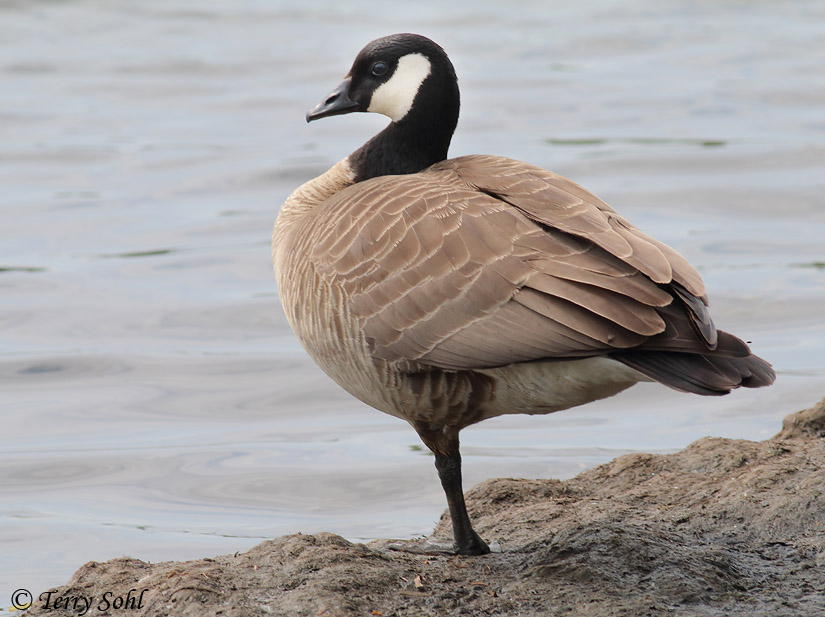 | 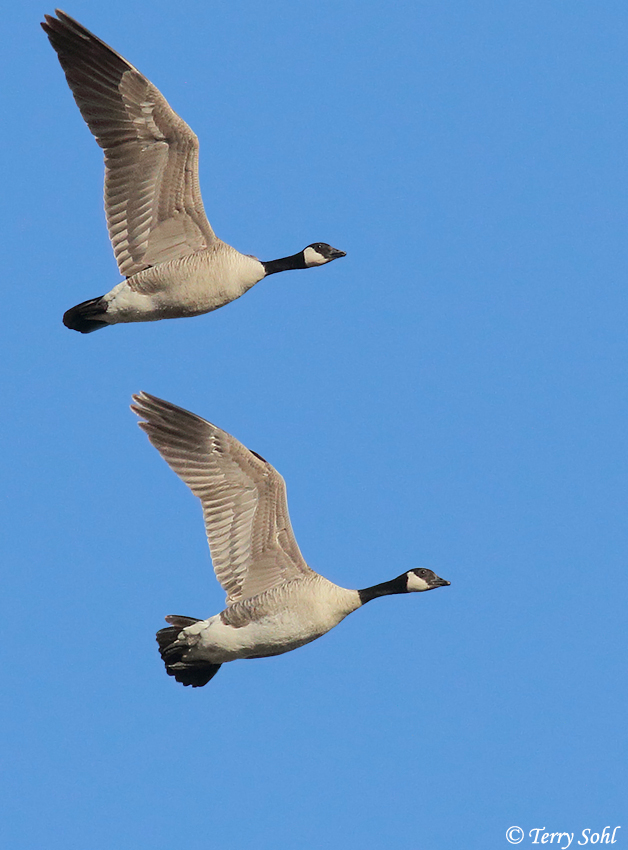 | 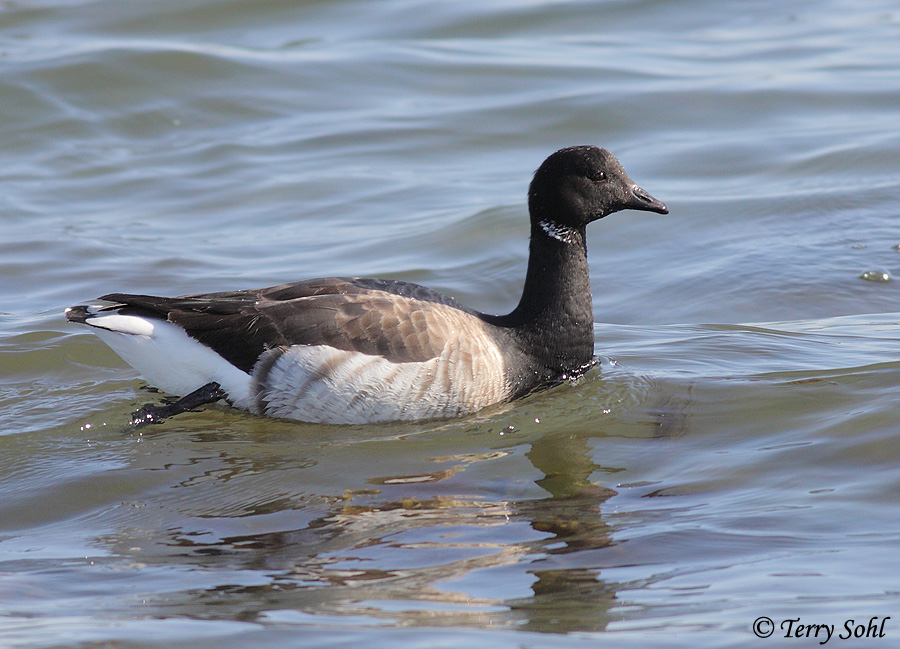 |  |
| Cackling Goose | Cackling Goose | Brant | Brant |
Conservation Status
Widespread and very common. Numbers of Canada Geese today are undoubtedly much higher than they were prior to European settlement of North America, as they've adapted extremely well to a human presence, learning to take advantage of agricultural fields, and open water in winter as a result of human activity (near river reservoir dams, urban parks, warm water discharge from power plants, etc.). The IUCN lists the Canada Goose as a species of "Least Concern".
Photo Information
April 10th, 2011 - Near Tea in Lincoln County, South Dakota - Terry Sohl
Audio File Credits
- 1Sunny Tseng. Recorded near Vancouver, Canada on February 28th, 2020. Original file and recording from xeno-canto.
- 2Peter van Vlaardingen. Recorded in Utrecht in the Netherlands on November 2nd, 2019. Original file and recording from xeno-canto.
- 3Bruce Lagerquist. Recorded in Oakland County, Michigan on May 25th, 2018. Original file and recording from xeno-canto.
