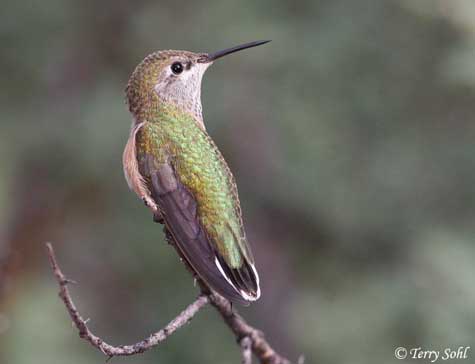
The Calliope Hummingbird is the smallest bird found in the United States, weighing only one-tenth of one ounce, and only reaching 3 inches in length. Despite their small size and delicate appearance, they breed in the relatively cold and harsh higher elevations of the western United States and Canada, and migrate all the way to southern Mexico for the winter.
Habitat
In its summer breeding habitat, they are found at high elevations in the western mountains of the U.S. and Mexico. They prefer shrubby areas, often near a water source. They commonly use clear-cut forest areas that have experienced some shrubby second-growth. They can be found in nearly any kind of habitat during migration.
Diet
Feeds primarily on nectar. Also will feed on tiny insects, and will drink sap from holes created by sapsuckers.
Behavior
Unobtrusive and less aggressive than larger hummingbirds, often feeding low in the flowers and away from more aggressive competitors.
Breeding
Non-breeder in South Dakota. In their breeding range, Calliope Hummingbird nests in open mountain woodlands, brushy slopes, and streamside thickets of the western United States. The female alone builds a tiny cup-shaped nest of plant down, soft fibers, and lichens bound with spider silk, usually placed on a slender conifer or shrub branch. She lays 2 tiny white eggs and solely handles incubation and feeding of the nestlings until the young fledge about three weeks after hatching.
Song
Generally silent, but with occasional high tsip, sometimes repeated.
Migration
Summers in the mountains of the western United States and Canada. Winters in southern Mexico.
Similar Species
Rufous Hummingbird , Broad-tailed Hummingbird. Calliope Hummingbird, Rufous Hummingbird, and Broad-tailed Hummingbird are best separated by size, color, and male throat pattern. Calliope is the smallest, with a short tail and in males a striking magenta throat made of narrow streaking rays rather than a solid patch. Rufous is slightly larger and warmer overall, often showing rich rusty-orange on the back, flanks, and tail, with males having a bright orange-red throat. Broad-tailed is the largest and more green-backed, with a longer tail, whitish underparts, and males showing a rosy-red gorget; in flight, male Broad-tailed often gives a distinctive loud wing trill that the other two lack.
Conservation Status
Generally stable throughout it's normal range. The IUCN considers the Calliope Hummingbird to be a species of "Least Concern".
Feeders
Will attend feeders for sugar water.
Photo Information
Red Rocks State Park near Sedona, Arizona - September 7th, 2006 - Terry Sohl
Interactive eBird Map
Click to access an interactive eBird map of species sightings for the Calliope Hummingbird
