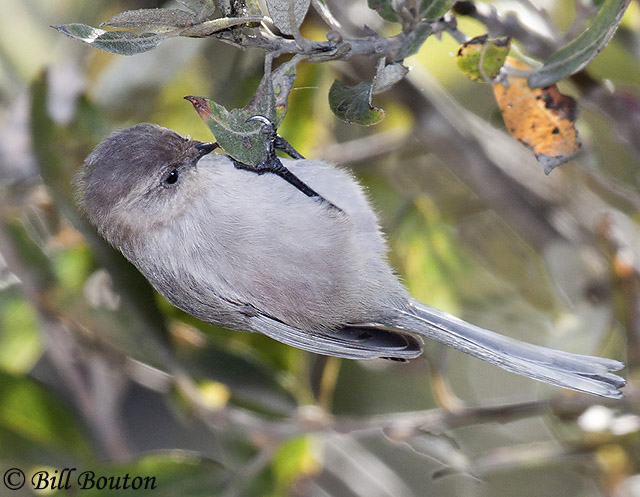
The Bushtit is one of the smallest birds in North America, but with nests seemingly built for a much larger bird. The drab little birds often go unseen as they forage, but their large, bag-shaped nests of up to a foot long are a common sight in bushes and trees in much of the western United States. They are the only member of the Aegithalidae family that is found in the New World, with six found in the Old World. There are some plumage variations between birds in geographic regions, with a "Black-eared Bushtit" race in eastern Arizona through Texas once considered a separate species.
Habitat
Found in a variety of brushy or forested habitats. They aren't typically found in the high mountains or deserts of the West, but can be found in a variety of forest types, riparian areas, thickets and shrublands, woodland edges, and residential areas with thick vegetation.
Diet
Mostly feeds on insects and spiders, but will also occasionally feed on fruits, berries, and seeds.
Behavior
Gregarious outside of the breeding season, typically foraging in small flocks. They are usually very active when feeding, climbing and flitting quickly through foliage and branches of vegetation, probing for insects. They are often seen hanging upside down as they forage.
Nesting
The nest of a Bushtit is often more obvious than the birds themselves, as they build unusually large hanging bag nests for their size, with nests up to a foot long. The nests it a tightly woven mixture of grasses, lichens, moss, spider webs, and other fibrous vegetation. The female lays between 5 and 7 eggs, and both parents help to incubate the eggs. Upon hatching, the young are tended to and fed by both parents. Bushtits often will raise two broods per year.
Song
Has a variety of vocalizations comprised of high-pitched buzzing chips and chattering notes.
Migration
Considered a permanent resident throughout most of its range. However there are some elevational movements in some areas in winter, with birds moving to lower elevations, and some other birds may move relatively short distances to warmer locations for the winter.
Interactive eBird Map
Click to access an interactive eBird map of Bushtit sightings
Similar Species
The Bushtit is most frequently confused with Kinglets and Blue-gray Gnatcatchers due to their shared tiny size and hyperactive foraging behavior. You can distinguish the Bushtit by its plain, brownish-gray plumage and notably long tail, lacking the bold white eye-rings of the Gnatcatcher or the bright crown patches and wing bars found on Kinglets. Additionally, Bushtits are highly social and almost always travel in "drifting" flocks of ten to forty birds, whereas Gnatcatchers and Kinglets are typically seen alone or in very small groups..
Conservation Status
Populations of Bushtit are strong and stable, and the IUCN lists them as a species of Least Concern" .
Further Information
Photo Information
Photo taken by Bill Bouton - November 5th, 2011 - San Luis Obispo County, California - Licensed under Creative Commons Attribution ShareAlike 2.0 Generic License.
