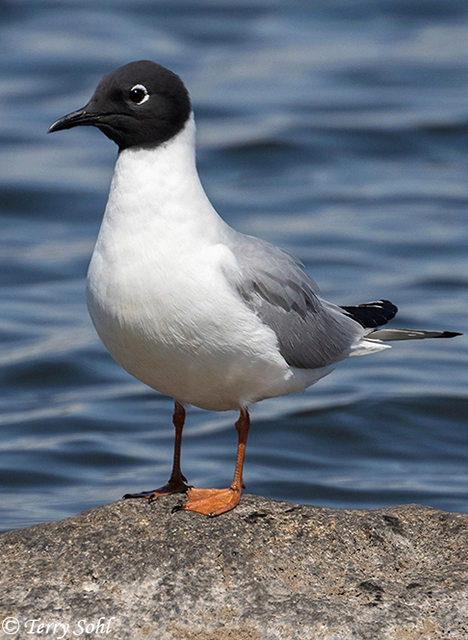
The Bonaparte's Gull is the smallest gull normally found in the South Dakota. One of the "black-hooded" gulls (in breeding plumage), they are smaller and more delicate than their cousin the Franklin's Gull, another species that can be found in South Dakota in migration. Unlike the Franklin's Gull however, which may stay and breed in certain locations in the state, Bonaparte's Gulls are birds of the boreal forest, living in and around shorelines surrounded by forest. Bonaparte's Gulls are unique in that they next in trees, rather than on the ground like most gull species. The species was named after a distant cousin of Napoleon.
Habitat
Usually near rivers and lakes during migration through the state. During the summer breeding season, they are found along lakeshores and riversides bordered by coniferous forest.
Diet
Insects, fish, crustaceans, but mostly insects on migration through the state.
Behavior
Forages while in flight, by dipping to the surface to pick up items or sometimes plunge-diving. They also can "fly-catch, snatching insects during flight, and will also pick up food items while wading or swimming.
Breeding
Non-breeder in South Dakota. In breeding range, the nest of a Bonaparte's Gull is a platform of sticks, lined with softer vegetative material such as grasses or moss, placed in a conifer tree, or sometimes on the ground. The female usually lays 3 eggs, and both parents help to incubate them. When the eggs hatch, both parents help to feed the young.
Song
Low harsh grrrrrr or reeeep is the most often heard call of birds in migration. Other calls heard near nesting sites include a longer, more drawn out greeeeeeeeeeeee.
- Click here to hear the harsh calls of a flock of Bonaparte's Gulls in flight1
- Click here to hear a more mellow call note of a pair of foraging Bonaparte's Gulls2
Migration
More common in the eastern part of South Dakota than in the west during migration. Summers in Canada and Alaska, winters along U.S. coasts and southward.
Interactive eBird Map
Click to access an interactive eBird map of Bonaparte's Gull sightings
Similar Species
Plumage similarities are present for many of the "black-hooded" gull species. For a more detailed comparison, click here to see identification tips for black-hooded gulls. It's impossible to list all the differences in all plumage conditions here (juveniles, winter plumaged birds, etc.), so most of the differences noted below are for breeding plumaged birds (although structural elements and some plumage patterns may persist regardless of the season). Similar species include the following:
- Franklin's Gull - In South Dakota, the two common black-hooded gulls are the Bonaparte's and the Franklin's. The Frankllin's is the larger and more robust of the two, while the Bonaparte's appears smaller and more delicate. In breeding plumage both share similar plumages, but the white around the eye is much more bold on a Franklin's Gull than a Bonaparte's. The bill of a Franklin's Gull is blackish-red, stouter, and shorter than a Bonaparte's, which has a thinner, black bill. On a bird at rest, the wings of a Franklin's gull show white spots, while they're more uniformly black on a Bonaparte's Gull. In flight the white triangle on the leading edge of the wings is distinctive on the Bonaparte's Gull.
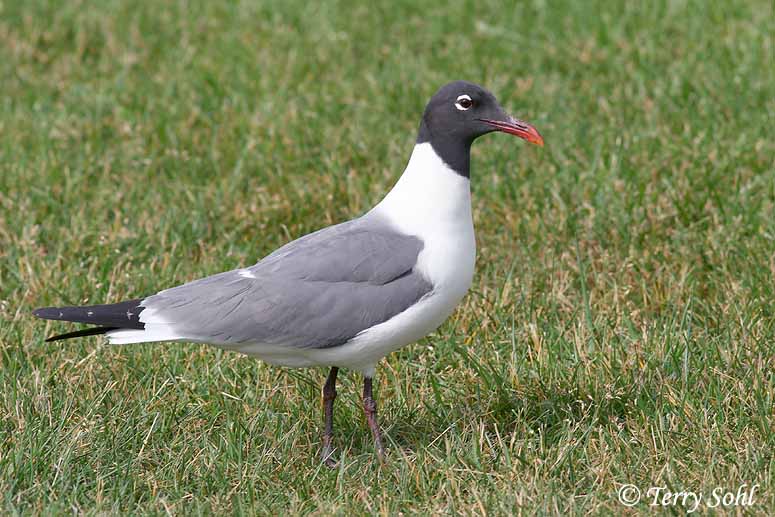
- Laughing Gull - A extreme rarity in South Dakota, although they have been sighted here on a few occasions. Laughing Gulls are substantially larger than Bonaparte's Gulls, with a much more robust, deepish red bill (compared to a thin black bill on a Bonaparte's Gull). The white arcs around the eyes are much more bold on a Laughing Gull than a Bonaparte's Gull. And as with all the other gulls on the list, Laughing Gulls lack the bold white triangle on the leading edge of the wing on a Bonaparte's Gull.
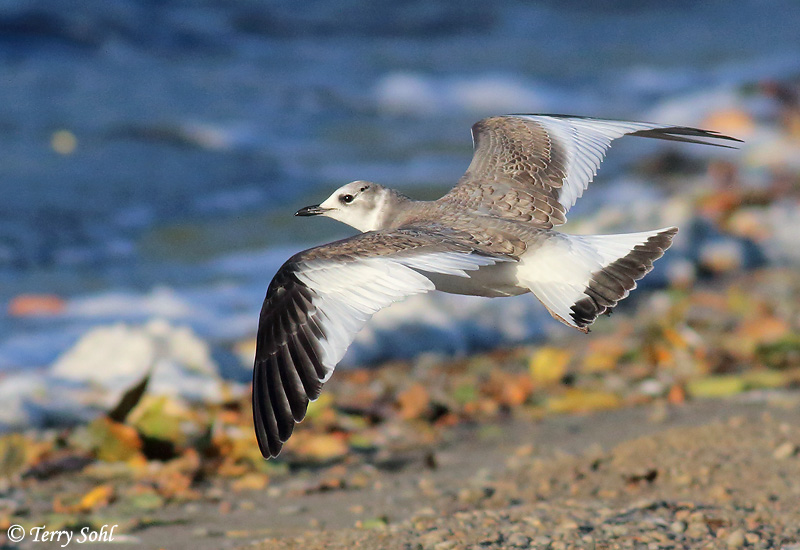
- Sabine's Gull - A rarity in South Dakota, although it seems one or a few have been sighted in the state each of the last several years. Sabine's Gulls are perhaps the gull most similar to a Bonaparte's in size, structure, and plumage. However, Sabine's Gulls in breeding plumage have a yellowish tip on their bill. In flight, plumage differences are striking, with Sabine's Gulls displaying a bold black triangle on the leading edge of the white, compared to a white triangle on a Bonaparte's Gull.
- Black-headed Gull. A species seen with increasing regularity in North America, they have been seen in surrounding states but not in South Dakota yet. Very similar in overall plumage (at rest), but Black-headed Gulls are larger and more robust looking, with a dark reddish-black bill as opposed to a thin black bill on a Bonaparte's Gull. The black on the hood of a Black-headed Gull isn't quite as extensive, extending backwards to a point behind the eye, while the black on a Bonaparte's Gull extends a bit further down the back of the neck.
 |
 |
 |
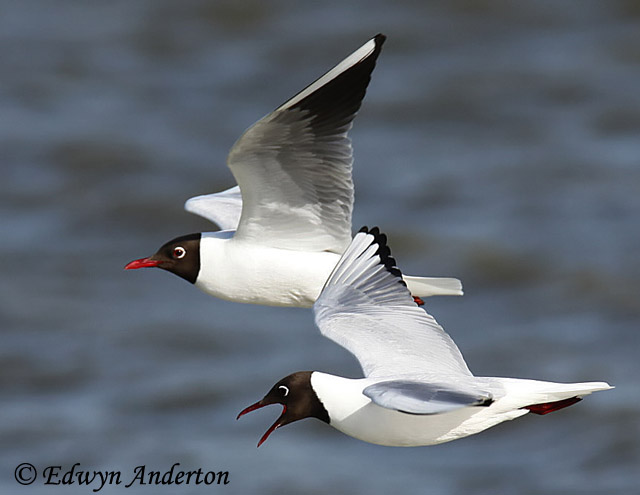 |
| Franklin's Gull | Laughing Gull | Sabine's Gull | Black-headed Gull |
Conservation Status
Bonaparte's Gulls are found over a very large geographic area, and are common in parts of their range. Overall populations are stable or increasing in most areas. The IUCN lists the Bonaparte's Gull as a species of "Least Concern".
Further Information
- eBird - Bonaparte's Gull
- Audubon Field Guide - Bonapartes Gull
- Cornell Lab of Ornithology - All About Birds: Bonapartes Gull
Photo Information
April 23rd, 2020 - Lake Whitewood, South Dakota -- Terry Sohl
Audio File Credits
- 1Paul Marvin - Recorded in Kennebunk, Maine on May 18th, 2018. Original recording and information from xeno-canto.
- 2Rachel Hudson - Recorded in Kitsap County, Washington on November 4th, 2018. Original recording and information from xeno-canto.
