| Length: 5.5 - 6.5 inches | Wingspan: 10.5 inches | Seasonality: All Seasons / Winter |
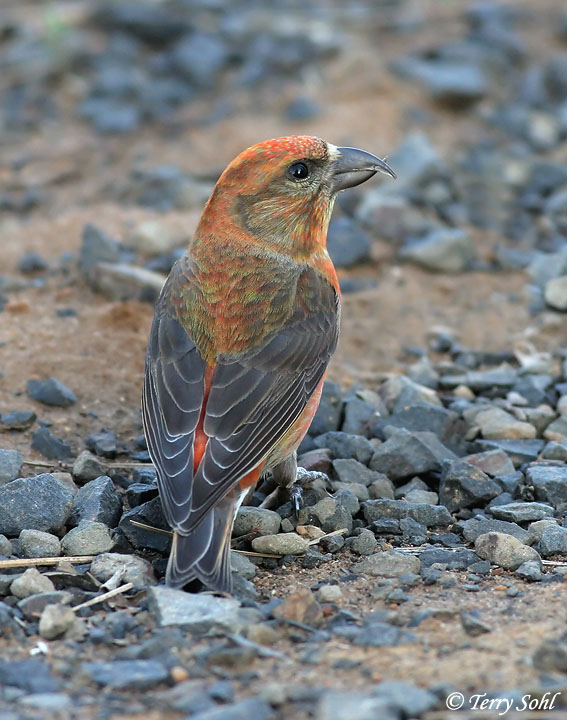
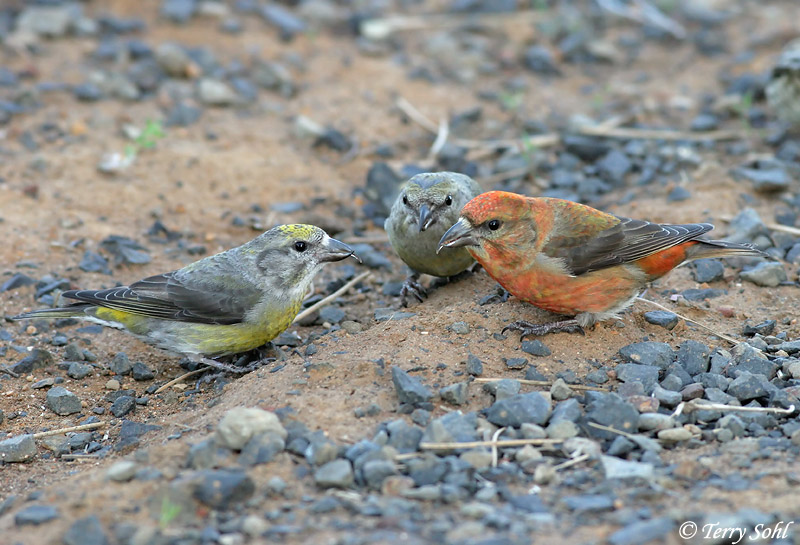
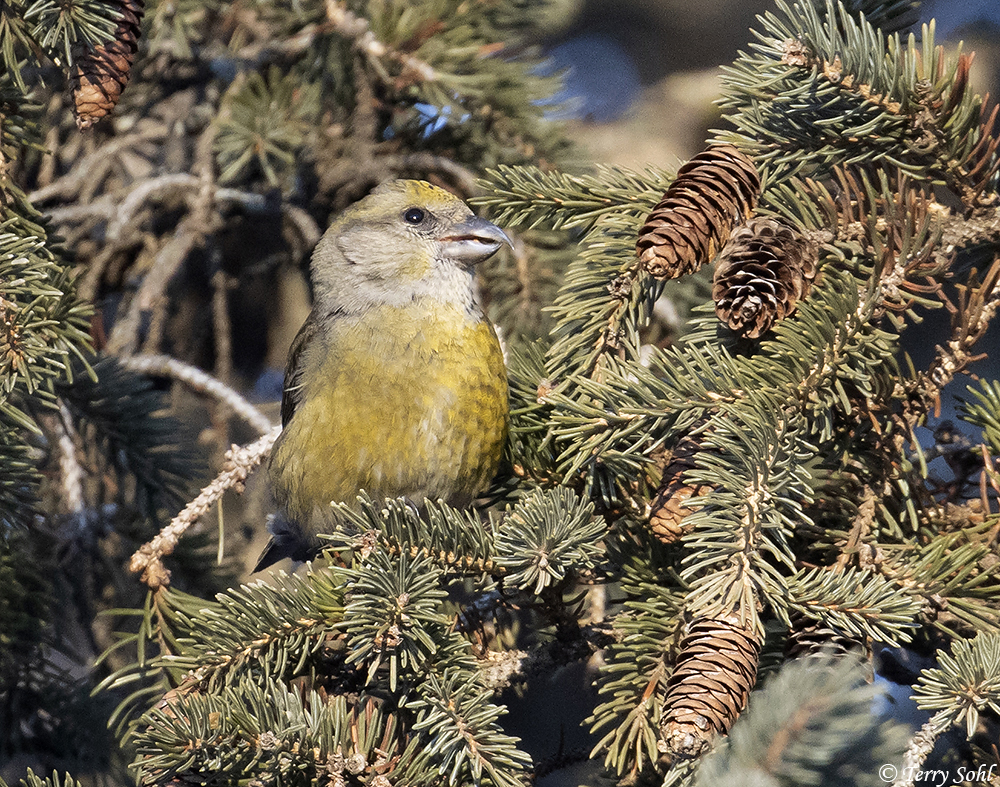
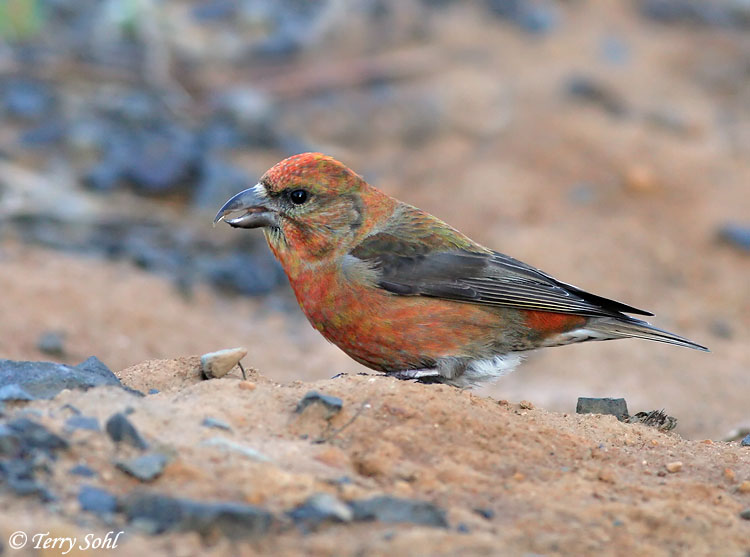
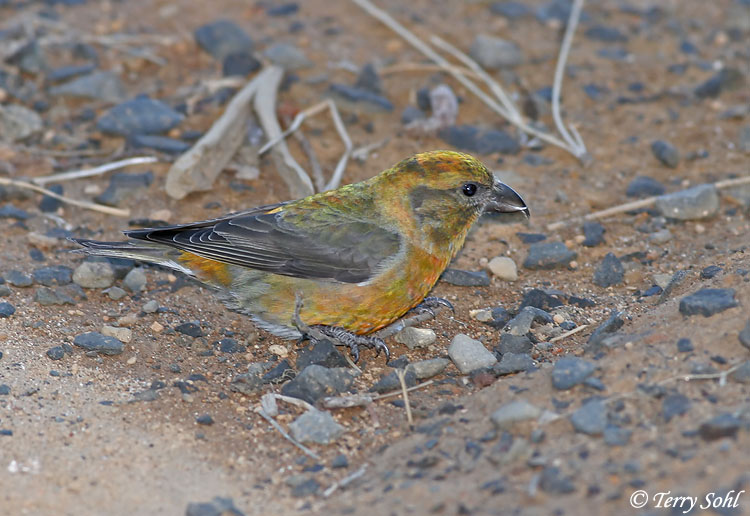
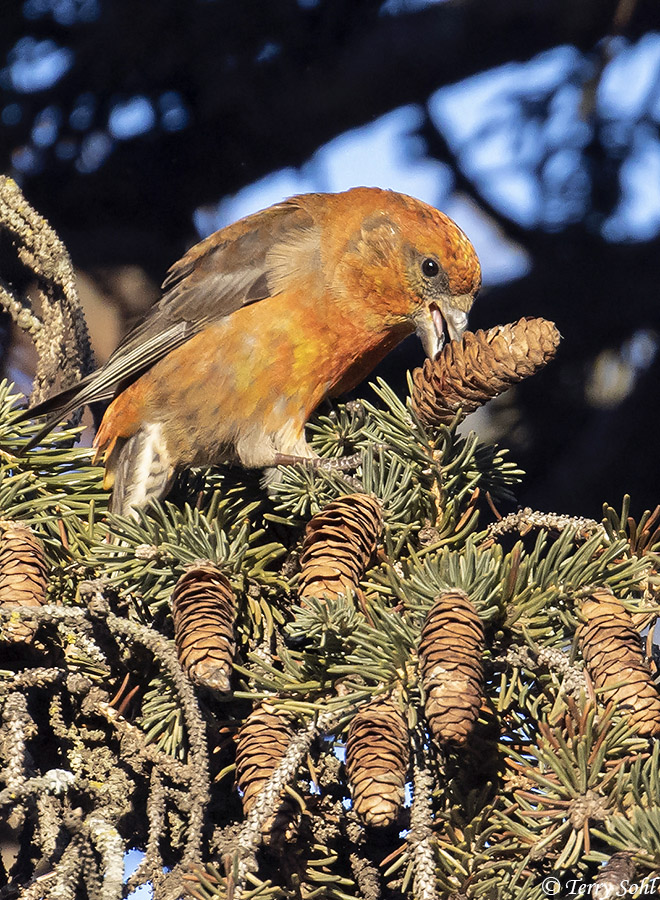
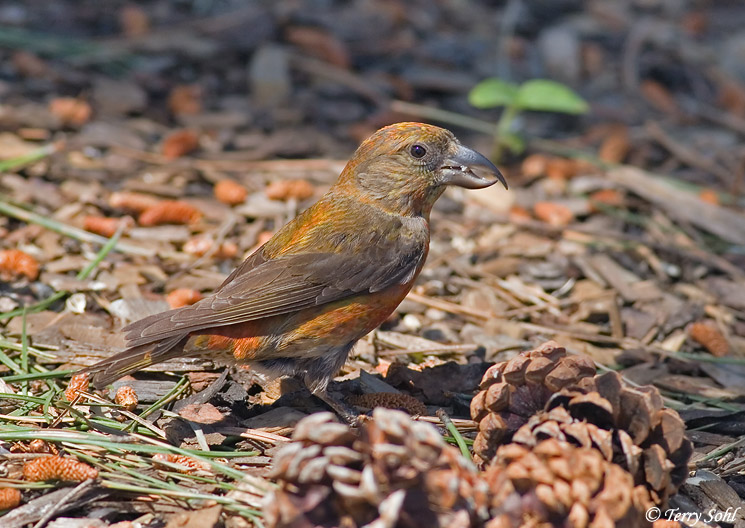
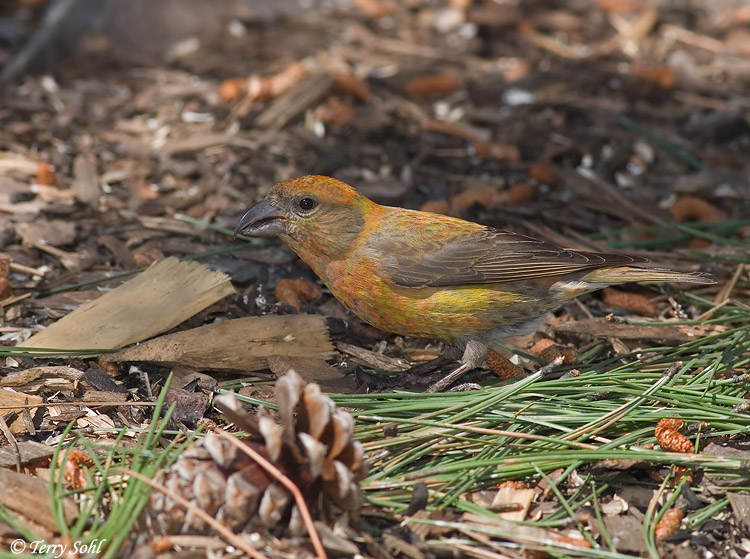
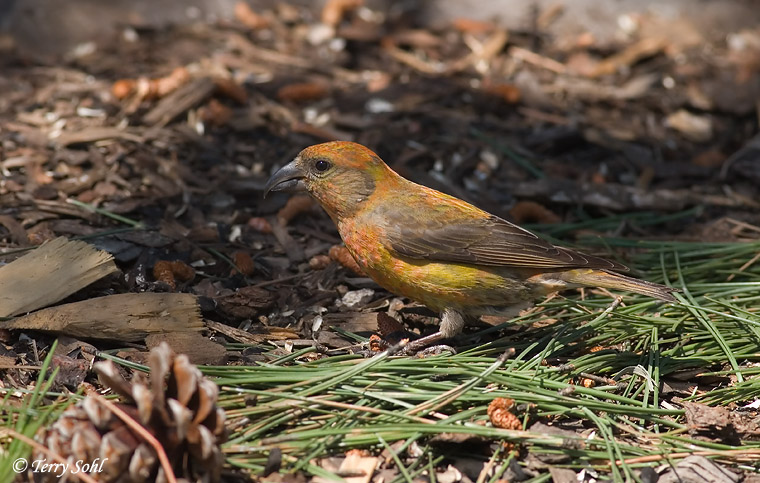
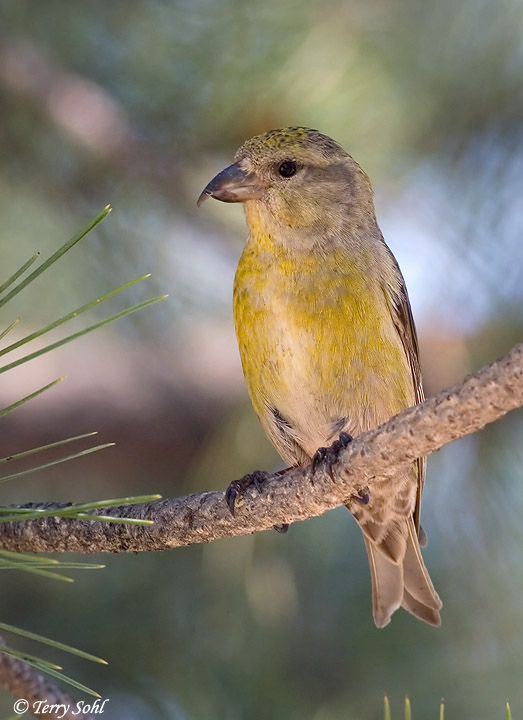
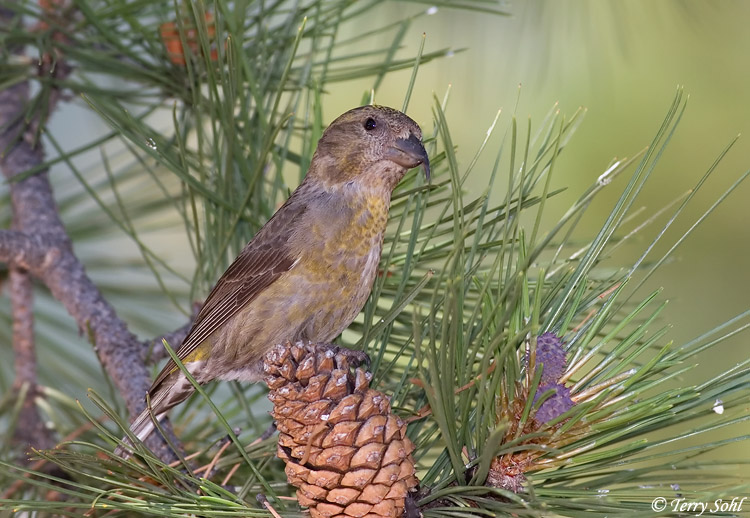
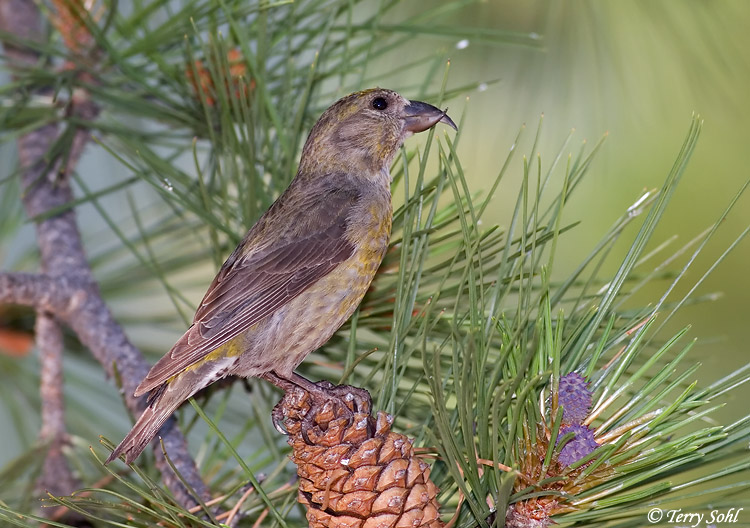
| ID Keys: Crossed bill, males red and females dull yellow, both with darker wings | ||
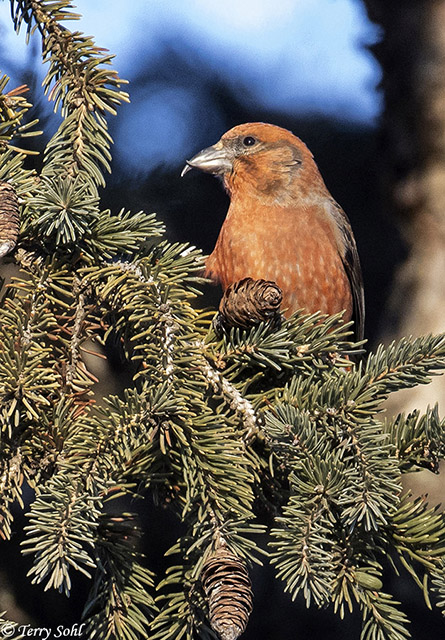 The
Red Crossbill is primarily a denizen of conifer forests due to its strong
preference for conifer seeds. However, flocks can be highly nomadic,
especially in winter. While normally frequenting the northern U.S., higher
elevations of the western U.S., and Canada, individual flocks may disperse
widely in the winter, moving long distances to the south, east, and towards
lower elevations. They have odd nesting habits, and will nest in nearly
any season if sufficient food items are available.
The
Red Crossbill is primarily a denizen of conifer forests due to its strong
preference for conifer seeds. However, flocks can be highly nomadic,
especially in winter. While normally frequenting the northern U.S., higher
elevations of the western U.S., and Canada, individual flocks may disperse
widely in the winter, moving long distances to the south, east, and towards
lower elevations. They have odd nesting habits, and will nest in nearly
any season if sufficient food items are available.
Red Crossbills are also a species with a great geographic diversity in songs and other minor characteristics. Depending on the source, there are 8 to 11 recognized sub-species (with constant rumors that they're about to be split into full, distinct species). "Type 2" Red Crossbills, sometimes called the "Ponderosa Pine Crossbill" (the bendirei or benti subspecies, depending upon source), is the one commonly found in the Black Hills, and in similar habitats further west in the United States. They're also the most likely subspecies to be found as winter visitors in the state. However, several of the other subspecies also have a tendency to sometimes stage winter irruptions, and spread widely from their core breeding areas. Type 3 and Type 4 Red Crossbills (the "Western Hemlock" and "Douglas Fir" subspecies, respectively) for example, both have a core breeding area near the Pacific coast of North America, yet sometimes irrupt all the way through the Great Plains. Thus, unless clear vocalizations are heard, it can be difficult to judge with any certainty which subspecies is being seen in winter in most locations in South Dakota.
Habitat:
They are rarely found long distances from conifer trees. Nomadic flocks may appear in suburban areas in winter, however, frequenting feeders.
Diet:
Red Crossbills primarily feed on the seeds of conifers. Individual sub-species often specialize in a specific type of conifer, such as bird specializing in pine, spruce, or hemlock species. They will also eat other seeds, tree buds, berries, and occasionally insects.
Behavior:
Red Crossbills are typically gregarious in all seasons. They usually forages in flocks in the foliage of conifers, climbing over cones and extracting seeds.
Nesting:
Red Crossbills are highly irregular nesters, with dates often timed to concur with best availability of cone crops. They have been known to breed in almost any season. However, that typically does not coincide with the typical breeding season of most North American birds, in the late spring and early summer. Given their dependence on cones of conifer trees, nesting often occurs in the early fall, when conifer cone crops are mature and available for feeding.
The nest of a Red Crossbill is placed in a conifer tree, typically in an area with dense foliage on a branch near the tree's trunk. The gregarious nature of a Red Crossbill also often extends through breeding, with loose colonies of nests scattered through one general area. The nest itself is constructed of pine needles and lined with finer materials such as grasses, weed stems, hair, moss, or feathers. The female lays 3 to 5 eggs, with both parents helping to incubate them. The young hatch after 14-16 days, with both parents tending to and feeding the young. They fledge from the nest 18-21 days after hatching.
Song:
Song is a series of short phrases with interspersed call notes. Song depends upon race/sub-species, with distinct songs for each of 9 possible sub-species. Calls (often given in flight) are also different among the different sub-species, but are generally similar to a high-pitched chew-chew.
- Click here to hear the calls of a Red Crossbill (type 2 - "benti")1
- Click here to hear the flight calls of a Red Crossbill (type 2 - "benti")2
- Click here to hear the song of a Red Crossbill (type 2 - "benti")3
Migration:
Generally a semi-permanent resident in much of its range. However, individual groups can be highly nomadic, and long distance dispersion the the south, east, and into lowland areas can occur in the winter. In South Dakota, Red Crossbills are only commonly seen outside the Black Hills during the winter months.
Interactive eBird Map:
Click here to access an interactive eBird map of Red-Crossbill sightings
Similar Species:
There are multiple other crossbill and finch species in South Dakota that could potentially be confused with a Red Crossbill.
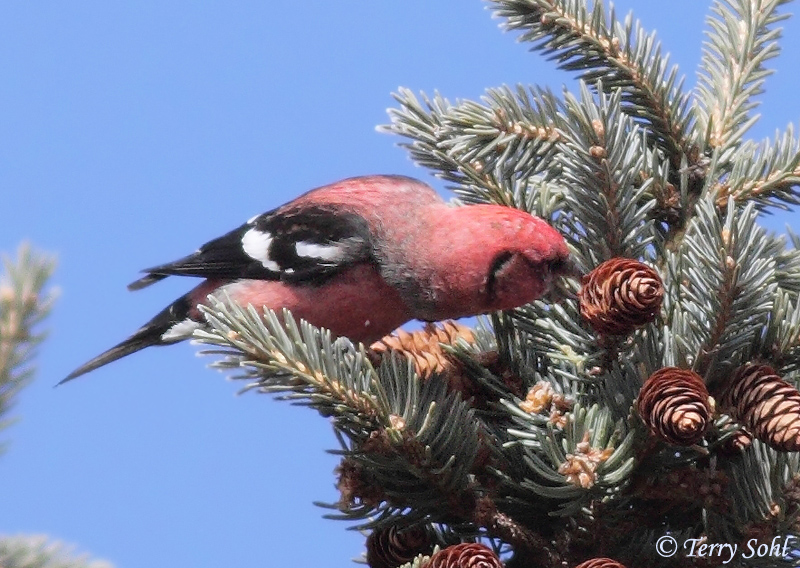
- White-winged Crossbill - As the namesake implies, White-winged Crossbills have 2 white wingbars that are lacking on Red Crossbills. Male White-winged Crossbills have black wings, while male Red Crossbills have dark brownish wings Body color is also different on mature males, as male White-winged Crossbills are more of a raspberry color, while male Red Crossbills are an orangish-red. Female White-winged Crossbills tend to have more streaking than female Red Crossbills.
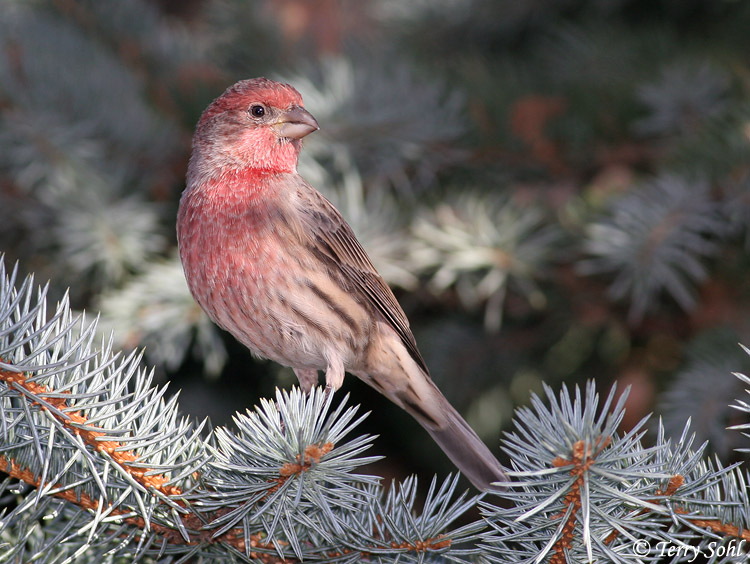
- House Finch - One of the most common finch species throughout the state, males have substantial red and could be confused with Crossbills if not seen well. However, they have a more traditional finch bill as opposed to the namesake bill of the Red Crossbill. Male House Finch are more of a raspberry color, with plainer backs and streaked flanks, while Red Crossbill males are more uniformly orangish-red. Female House Finch lack the yellow of a mature female Red Crossbill, and thus are unlikely to be confused with them. However, juvenile Red Crossbills are plainer and streaked like a female House Finch. The House Finch is smaller though, and again, the bill differences are obvious.
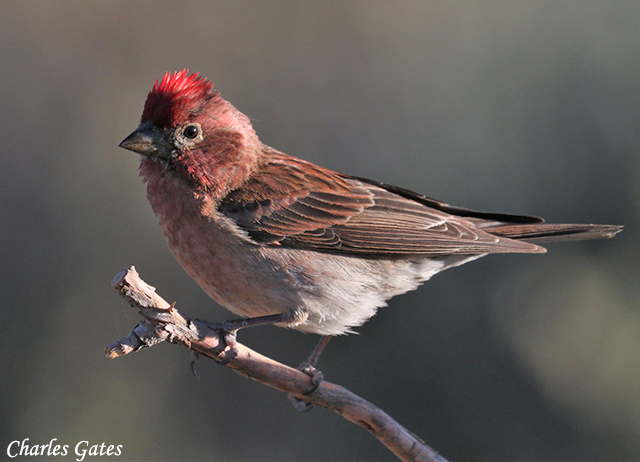
- Cassin's Finch - Cassin's Finch are very similar in appearance to House Finch in both male and female plumages. While plumage differences exist, the same identification keys for differentiating House Finch from Red Crossbills also apply to Cassin's Finch
- Purple Finch - Purple Finch are very similar in appearance to Houe Finch in both male and female plumages. While obvious plumage differences exist, the same identification keys for differentiating House Finch from Red Crossbills also apply to Purple Finch.
 |
 |
 |
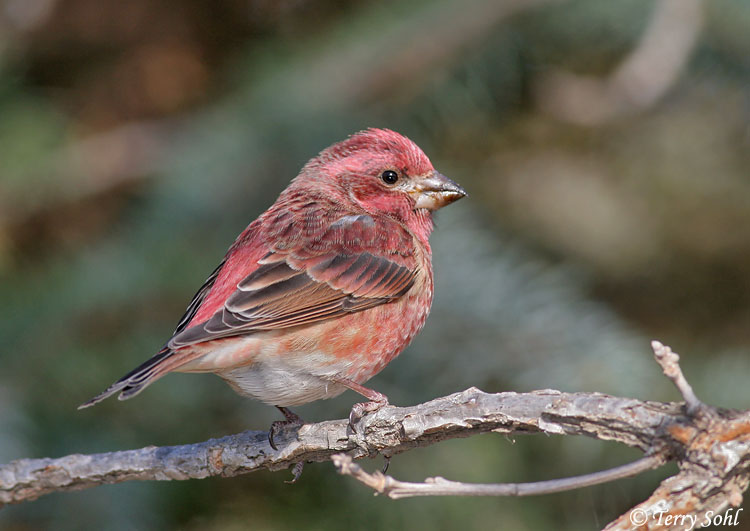 |
| White-winged Crossbill | House Finch | Cassin's Finch | Purple Finch |
Bird Feeders:
Will attend feeders for sunflower seeds, occasionally for other seeds, as well as peanuts, suet, and sometimes fruit.
Conservation Status:
Red Crossbills are found across a very large geographic range (in both the Eastern and Western Hemispheres), they are common in parts of that range, and overall populations are strong. Systematic surveys in recent decades such as the Breeding Bird Survey and Christmas Bird Count indicate stable populations. The IUCN thus considers the Red Crossbill to be a species of "Least Concern".
Further Information:
- Patuxent Bird Identification InfoCenter, Red Crossbill
- WhatBird - Red Crossbill
- Audubon Guide - Red Crossbill
Photo Information:
January 5th, 2020 - Sioux Falls, South Dakota - Terry Sohl
Additional Photos:
Click on the image chips or text links below for additional, higher-resolution Red Crossbill photos.
Audio File Credits:
- 1Connor Cochrane. Recorded in Marin County, California on November 14th, 2020. Original recording and information available from xeno-canto.
- 2Richard E. Webster. Recorded in San Diego, California on May 19th, 1998. Original recording and information available from xeno-canto.
- 3Andrew Spencer. Recorded in Montezuma County, Colorado on July 13th, 2007. Original recording and information available from xeno-canto.
| Click on the map below for a higher-resolution view |
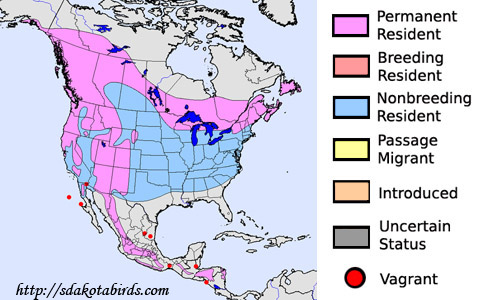 |
| South Dakota Status: Common permanent resident in the Black Hills. Uncommon migrant and breeder elsewhere in the western part of the state. Irregular but sometimes common winter visitor in the north, irregular and uncommon to rare in the southeast part of the state. |
Additional Red Crossbill Photos
Click for a higher-resolution version of these photos



ALL PHOTOS COPYRIGHTED. Click below if you have interest in any of these photos for:
| Commercial Use |
| Fine Art Print |
| Personal Usage |
SOUTH DAKOTA BIRDS AND BIRDING - LOCATIONS OF WEBSITE VISITORS
Please mail all comments/suggestions/gripes/complaints to: Dakota Birder
Click here for other references used to compile this page