| Length: 12 inches | Wingspan: 25 inches | Seasonality: Rare migrant / Summer |
| ID Keys: Most easily identified by voice. Rich brown overall, chest darker than throat. | ||
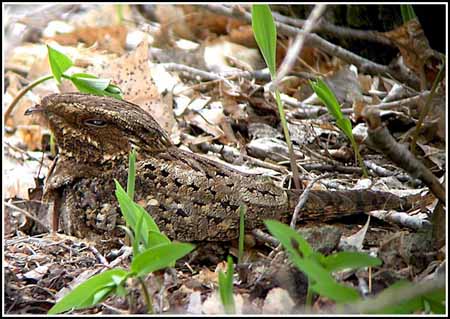 One
of the nocturnal Nightjars, the Chuck-Will's-Widow is named after its
continuous, repetitive song that is often heard at night. Primarily a
bird of the southeastern United States, they are rare visitors to the state.
Extremely shy, Chuck-Will's-Widows will generally flush upon approach,
moving away on silent wings.
One
of the nocturnal Nightjars, the Chuck-Will's-Widow is named after its
continuous, repetitive song that is often heard at night. Primarily a
bird of the southeastern United States, they are rare visitors to the state.
Extremely shy, Chuck-Will's-Widows will generally flush upon approach,
moving away on silent wings.
Habitat: Wooded habitats, including conifer, deciduous, and mixed forests.
Diet: Primarily insects, especially large flying insects that are active at night. Also will eat small birds, up to any size they can swallow whole.
Behavior: Nocturnal, foraging at night. Captures insects in mid-air in its extremely large gaping mouth, either by flying out from a perch or the ground to snag passing insects, or by foraging while in constant flight.
Breeding: Rare breeder in South Dakota (Breeding Bird Survey map unavailable).
Song: Chuck-Will's-Widow Song
Migration: Summers in the southeastern quarter of the United States. Winters in Mexico, Central America, and northern South America, with some over-wintering in Florida.
Interactive eBird Map: Click for access to an interactive eBird map of Chuck-will's-Widow sightings
Similar Species: Whip-poor-will
Conservation Status: Possibly declining in parts of its range, due to habitat loss.
Further Information: 1) Patuxent Bird Identification InfoCenter, Chuck-Will's-Widow
2) WhatBird - Chuck-will's-widow
3) Audubon Guide - Chuck-will's-widow
Photo Information: May 3rd, 2003 -- Cottonwood Forest below Oahe Dam in Stanley County - Doug Backlund
| Click on the map below for a higher-resolution view |
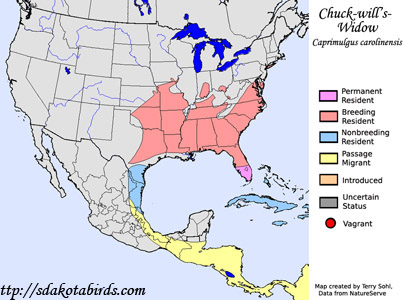 |
| South Dakota Status: Prior to 2000, the nearest confirmed breeding was in Kansas and southeastern Iowa. Doug Backlund confirmed breeding near Oahe Dam in 2000, with records continuing in the summer in the same area since that date. |

ALL PHOTOS COPYRIGHTED. Click below if you have interest in any of these photos for:
| Commercial Use |
| Fine Art Print |
| Personal Usage |
SOUTH DAKOTA BIRDS AND BIRDING - LOCATIONS OF WEBSITE VISITORS
Please mail all comments/suggestions/gripes/complaints to: Dakota Birder
Click here for other references used to compile this page